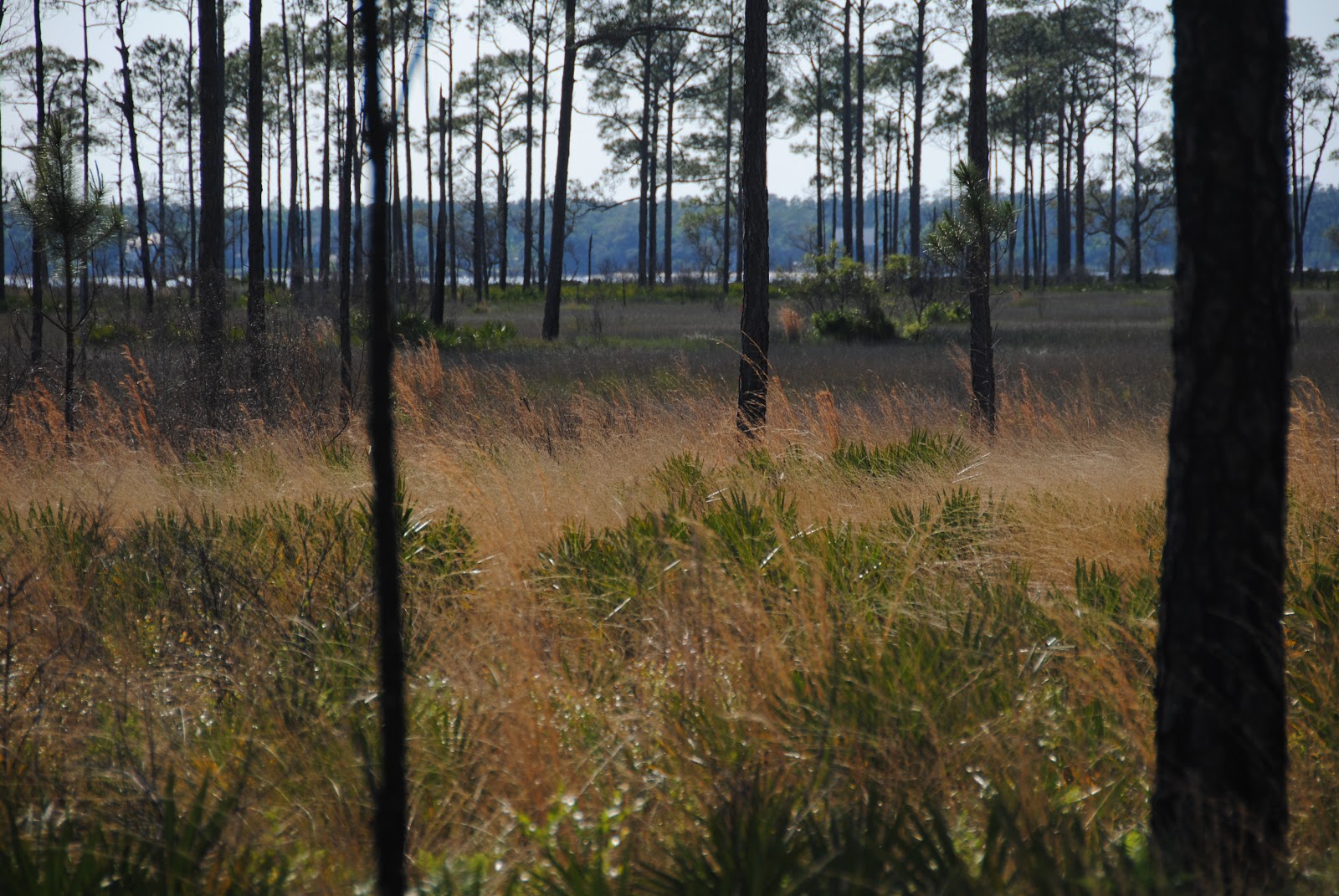
Field Notes from November 15, 2015
Provided I can get enough of my grad schoolwork and housework done on Saturday, I sometimes spend a lazy Sunday afternoon birdwatching. Of course, if the opportunity arrises, I can't help but do a little herping and bugging to the side.
There were patchy clouds in the sky and some growing thunderheads to the west threatened rain at Johnson Beach, Gulf Islands National Seashore. If the sun was shining, it was warm, but if the clouds covered its power, a cold wind chilled the ground. It would seem that this chill was too much for one anole (Anolis carolinensis), which lay dead and crispy on the leaflitter underneath an Ilex vomitoria plant. I stumbled upon the grim spectacle at the same time as a large, 1.3-meter black racer (Coluber constrictor) noticed the fried lizard. Of course, I noticed the snake before I even realized that it was eyeing up frosty leftovers. I started snapping pictures immediately and documented the whole process from mouth to stomach. Apparently, racers are not above scavenging.
 |
| Coluber constrictor at Johnson Beach, Gulf Islands National Seashore. |
 |
| Coluber constrictor at Johnson Beach, Gulf Islands National Seashore. |
 |
| Coluber constrictor at Johnson Beach, Gulf Islands National Seashore. |
I noticed an elderly lady walking her pug down the boardwalk as I crouched, observing the process. I motioned for her to approach slowly but it was too late. The snake moved off into the shrubbery and she couldn't see it in the shadows of the
Ilex. Farther along the boardwalk I met her husband. He was a little more enthusiastic about the prospect of seeing a snake than his wife and I took him over to where I'd spotted it before. Of course, it was long gone.
Anyways, the purpose of this stroll was to birdwatch so I'll cut to the chase.
Mergus serrator - A few red-breasted mergansers were fishing in Big Lagoon, on the north side of the island.
Some tracks in the dunes may indicate the presence of the northern bobwhite (
Colinus virginianus).
Gavia immer - There were a couple common loons in Big Lagoon and one flew overhead on the Gulf side.
There was a possible
Podiceps (grebe) on the Gulf but I only got one fleeting glimpse before it dove and I never saw it resurface.
Pelecanus occidentalis - Several brown pelicans flew casually over the island.
Ardea herodias - A several great blue herons were spotted either fishing in the shallows of Big Lagoon, strolling among fishermen on the Gulf side, or resting among the dunes. One even walked across the road in front of me, apparently unafraid of my vehicle.
Charadrius nivosus - It was a little challenging for me to identify this one. At first I thought it was a semipalmated plover (
C. semipalmatus) but the head patterns weren't quite lining up. Then I noticed the breastband wasn't complete and I knew it couldn't be the semipalmated. I think this may be my first personally confirmed record of the snowy plover.
Tringa semipalmata - The willet is always present at any beach on the Gulf, or so it would seem. I spotted several of them but I know I ignored at least a few others.
Arenaria interpres - One ruddy turnstone was chasing waves on the Gulf side.
Calidris alba - I know for sure that at least half a dozen of these birds were on the Lagoon side but I didn't take the time to identify every little sandpiper or peep that I came across. There could be other species present.
There were certainly many gulls around, probably
Leucophaeus atricilla (laughing gull), but I didn't focus on gulls.
Thalasseus maximus - A flock of about half a dozen royal terns flew overhead, following the shoreline on the Lagoon side.
Columba livia - One rock pigeon near the public beach access.
Mimus polyglottos - A common sight anywhere in Florida, I spotted at least a few northern mockingbirds at the shrubby, west-end of the park.
Setophaga coronata - Yellow-rumped warblers are common in most Florida habitats. I identified a couple of them for certain, though there were likely many more.
Melospiza melodia - A pair of song sparrows were in the shrubbery in the dunes. I saw other sparrows as well but I couldn't identify them with certainty.
 |
| Setophaga coronata at Johnson Beach, Gulf Islands National Seashore. |
 |
| Ardea herodias at Johnson Beach, Gulf Islands National Seashore. |
 |
| Ardea herodias at Johnson Beach, Gulf Islands National Seashore. |
 |
| Orthoptera at Johnson Beach, Gulf Islands National Seashore. |
 |
| Calidris alba at Johnson Beach, Gulf Islands National Seashore. |
 |
| Calidris alba at Johnson Beach, Gulf Islands National Seashore. |
 |
| Tringa semipalmata at Johnson Beach, Gulf Islands National Seashore. |
 |
| Tringa semipalmata at Johnson Beach, Gulf Islands National Seashore. |
 |
| Calidris alba and Tringa semipalmata at Johnson Beach, Gulf Islands National Seashore. |
 |
| Tringa semipalmata at Johnson Beach, Gulf Islands National Seashore. |
 |
| Calidris alba and Tringa semipalmata at Johnson Beach, Gulf Islands National Seashore. The smaller bird was trying to steal the larger's worm snack. |
 |
| Tringa semipalmata at Johnson Beach, Gulf Islands National Seashore. |
 |
| Tringa semipalmata at Johnson Beach, Gulf Islands National Seashore. |
 |
| Danaus plexippus at Johnson Beach, Gulf Islands National Seashore. |
 |
| Tringa semipalmata at Johnson Beach, Gulf Islands National Seashore. |
 |
| Calidris alba at Johnson Beach, Gulf Islands National Seashore. |
 |
| Danaus plexippus at Johnson Beach, Gulf Islands National Seashore. |
 |
| Gavia immer at Johnson Beach, Gulf Islands National Seashore. |
 |
| Tringa semipalmata at Johnson Beach, Gulf Islands National Seashore. |
 |
| Tringa semipalmata at Johnson Beach, Gulf Islands National Seashore. |
 |
| Tringa semipalmata at Johnson Beach, Gulf Islands National Seashore. |
 |
| Ardea herodias at Johnson Beach, Gulf Islands National Seashore. |
 |
| Tringa semipalmata at Johnson Beach, Gulf Islands National Seashore. |
 |
| Danaus plexippus at Johnson Beach, Gulf Islands National Seashore. |
 |
| Danaus plexippus at Johnson Beach, Gulf Islands National Seashore. |
 |
| Tringa semipalmata at Johnson Beach, Gulf Islands National Seashore. |
 |
| Tringa semipalmata at Johnson Beach, Gulf Islands National Seashore. |
 |
| Johnson Beach, Gulf Islands National Seashore. |
 |
| Johnson Beach, Gulf Islands National Seashore. |
 |
| Ocypodinae at Johnson Beach, Gulf Islands National Seashore. |
 |
| Dead Brachyura at Johnson Beach, Gulf Islands National Seashore. |
 |
| Charadrius nivosus at Johnson Beach, Gulf Islands National Seashore. |
 |
| Arenaria interpres at Johnson Beach, Gulf Islands National Seashore. |