Pages

Showing posts with label Vancouver Island. Show all posts

Saturday, 7 January 2017

Life on Mount Washington

August 17, 2016

This little guy was begging us for food. Juvenile grey jays, like this one, may never develop the ability to find food for themselves if they get handouts from humans. When winter rolls around, he may starve.
Mount Washington is home to an alpine resort, ski village, mountain biking club, hiking trails, and many other tourist attractions. So, needless to say, the challenges faced by wildlife and vegetation are usually rooted in human causes.
Vegetation has a particularly challenging prospect. The face of the mountain may be criss-crossed by ski trails, chair lifts, and hiking paths, but crowds of people still feel the urge to tromp out of bounds. The authorities do their best to keep the folks on the trails but the imagination of many people dictates that they pursue the better view through the underbrush.
Colorful lichens grow on the rocks by the trail. They are often the first organisms to colonize mountainous habitats so, when an area is disturbed (such as a trail), they may cling on when other forms of vegetation have been vanquished.
Animals also have to cope with human influences and some are all to eager to take advantage of our sentiments. Possibly the most famous example of animal-human interactions is that involving food. On Mount Washington, the grey jay is the primary offender. This small bird is so accustomed to human handouts it will even land on outstretched limbs, provided there is a snack in the palm. Like deviating from the trail, a close encounter with a mountain bird is nearly impossible to resist. Of course, the birds don't really benefit from being fed. For starters, junk food isn't healthy for anyone. Second, when the juvenile birds become addicted to the human trash, they won't know what to do with themselves when winter rolls around. In other words, feeding the birds, eliminates their ability to fend for themselves. They never learn. As a result, populations of grey jays have actually declined because youngsters aren't surviving the winter.
A western meadow fritillary warms itself on the grey stones lining the paths on Mount Washington. The insects on the mountain generally avoid people, but we did encounter a nest of small wasps that swarmed anyone who stood too long on the boardwalk overlooking the Forbidden Plateau. Fortunately, they were too small to cause people any discomfort.
On the other hand, people learn to love the things they can touch. A bird landing on a child's hand is a very positive interaction with nature for a kid. It teaches him to love nature and that may be more important than that particular bird's ability to survive. Every kid that grows up loving wildlife is a victory for nature.
A grey jay junky casts a hopeful glance in my direction.

The View from Mount Washington

August 17, 2016

I may have gotten a little carried away with panoramas.
I'm aware there are multiple mountains in the world that have been named Mount Washington. The one that I visited this summer was on Vancouver Island, off the west coast of British Columbia. Mount Washington was name, so they say, because from the east coast of the Island, it looks like the skyward facing silhouette of President George Washington's face. Enjoy these photos from my trip up the mountain with my parents during my brief time back home.

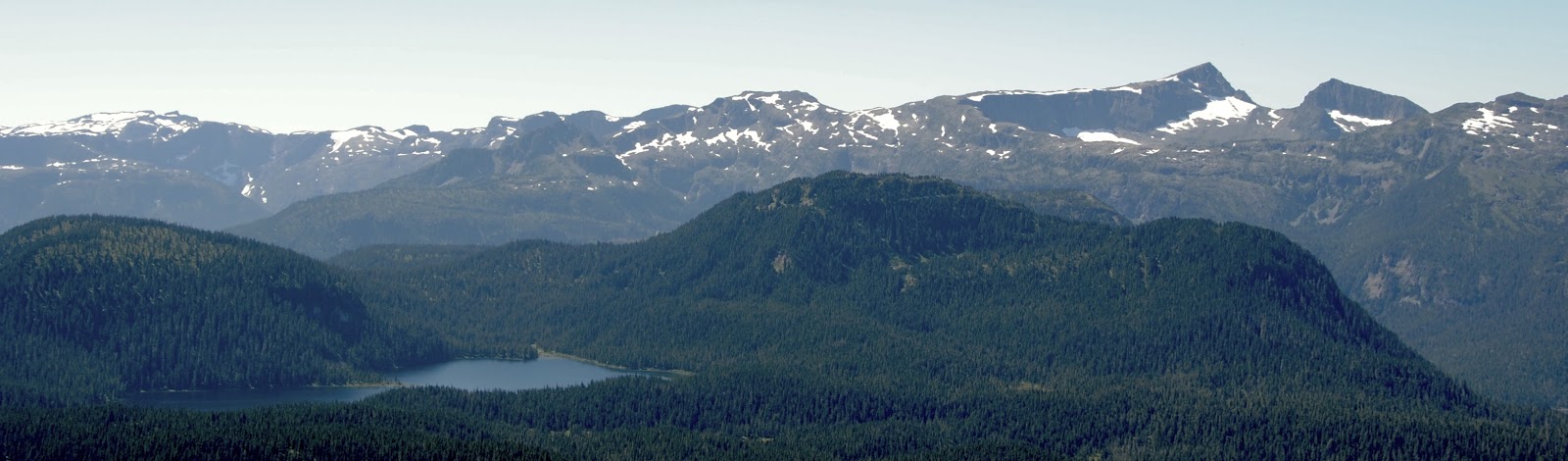
Vancouver Island is riddled with lakes. Below, the Forbidden Plateau rolls out as green mounds of trees beneath the brown backbone of the Island.
Some ponds way down in Forbidden Plateau.
To the south, another set of high-rising hills pushes through the coastal plateau.
Another panorama of Vancouver Island backbone and the lakes of Forbidden Plateau.

Tuesday, 20 December 2016

British Columbia Beaver Ponds

December 19, 2014

Beavers have flooded the trail, diverting the waters of Stories Creek away from their dam. The western hemlocks in the background seem to be fairly flood-resistant.
I was born and raised on Vancouver Island, off the grey west coast of British Columbia. We seldom got snow and it seldom didn't rain. We called it a temperate rainforest, but it was far from tropical--mild winters and mild summers.
As a student in Florida, I missed the grey skies, wet forests, and short days. It was really made mandatory by my loving parents, but Christmas was always spent back home on the island. My siblings and I would fly up from Florida every December, just to be with family.
It proved to be precarious hiking over this trail-turned-creek. The deer ferns are evergreens that enjoy moist areas. Perhaps this is too moist.
I of course took this opportunity to get outside. My parents lived in a coastal fishing town called Campbell River and it rarely got snow. The forests surrounding the town were dark and wet, full of soggy, decaying wood and draped in mosses. Three colours predominated: brown, green, and grey. The grey sky sandwiched the green of the mosses and evergreens against the reddish-brown soil and tree trunks. I was looking for animal life, of course, but the forest was surprisingly quiet. It was late afternoon, but the sun was already setting somewhere behind the high, grey clouds. It made me feel alone, but not lonely. Rather, it was very peaceful. A quiet tit sound notified me of a thrush's presence. In the summer, it might be true that "birds of a feather flock together" but, in the winter, there is no prejudice. They seem to work together to flush up insects and watch for predators. This thrush was sending an early warning to someone about my presence. After several minutes of listening I could discern some other birds in the trees. Chestnut-backed chickadees, golden-crowned kinglets, varied thrushes, and even a few brown creepers. I walked another hundred meters up the trail and everything became silent again.
One of the Stories Creek beaver ponds as seen from the trail. It is amazing how much nostalgia can be associated with a place like this. Beavers and birds might be the only obvious critters here in December, but as early as January the long toed salamanders will be moving in to breed, superseded by a whole host of others, including northwestern salamanders, rough-skinned newts, red-legged frogs, and Pacific treefrogs.
The trail followed part of Woods Creek before taking an old, overgrown logging road across to Stories Creek. Both creeks were full and rushing from the latest rainfall. Some places on the island can get over three meters (ten feet) of rain a year. Soon, I was skirting the edges of the muddy trail to avoid getting anything past my ankles wet and leaning precariously over the trail to keep my scarf from catching on the wet shrubbery. The reason for the flooded trail had more to do with engineering than the water table. A beaver dam had grown out from one of the ponds and clogged the natural flow of water back to the creek. The trail made a fine spillway. I thanked God for my long legs and jumped over the obstacle.
Another one of the Stories Creek beaver ponds. Dusk had already arrived in the forest, it seemed, by 3pm.
There were several ponds up Stories Creek, all of them beaver-constructed. Originally, small dams and spillways were constructed along the stream to help salmon move and reproduce. It was originally part of the local gulf club's mitigation project but, now, the pressure-treated dams are in a sad state of decay. The club made up for the neglect by periodically smashing out sections of beaver dam. I hardly think that behavior is justified.
Sword ferns blanket the forest floor, under a stand of red alder. The ferns are evergreens and continue to grow tall until the first snowfall, which may never arrive.
As the forest became too dark to see the trail, I headed back toward home. My footsteps were the only sound and it made me uncomfortable. I found myself hurrying along, as if the growing darkness would only tolerate my disturbance for moments longer. Another thought comforts me: Rooibos tea. When I'm huddled by the wood stove, watching the lights on the Christmas tree, I'll have a cup of hot, rooibos tea.