Third Day - Sunday, May 24
Morning
 |
| A steam donkey was left to rust on the side of the trail; a reminder of bygone logging days along the west coast. Dad films the unit from the opposite side. |
 |
We took water from this creek for
drinking.
|
Darkness carpeted the dawn in a shroud of mist. The first golden rays of the dawn glanced over a horizon of waves and played on the shimmering spruce standing to greet the rising tide of the vast Pacific Ocean. One glimmering ray sent its radiant shaft through the dark bows of green and settled, warming the back of a small golden bird. Wilson's warbler, elegantly named
Wilsonia pusilla, ruffled his feathers and perked up the crest of his black-crowned cap. The sun rose quickly and the carpet of mist threatened to cover the sky's radiance if the sun rose to high.
Wilsonia lost no time and, with a flash of olive wings and yellow breast, lighted on a branch to soak in the fleeting warmth. Suddenly, he burst out in a warbling song as the sun highlighted his bubbling, warm breath. Soon, varied thrushes,
Ixoreus naevius, joined the chorus with a high wavering song and the robins,
Turdus migratorius, added their own beautiful melody of chirping notes. At the climax of the choir's masterpiece, a Pacific wren,
Troglodytes pacificus, chimed in with a tinkering warble that warmed the heart enough to spread the suns rays beyond the confines of external feeling. Then, with the conclusion of the song, the sun shifted its shine heavenward and the fog regained the earth.
 |
| Me, standing on the sandstone shelf. Is it just me, or does my chest look weird in this photo? |
 |
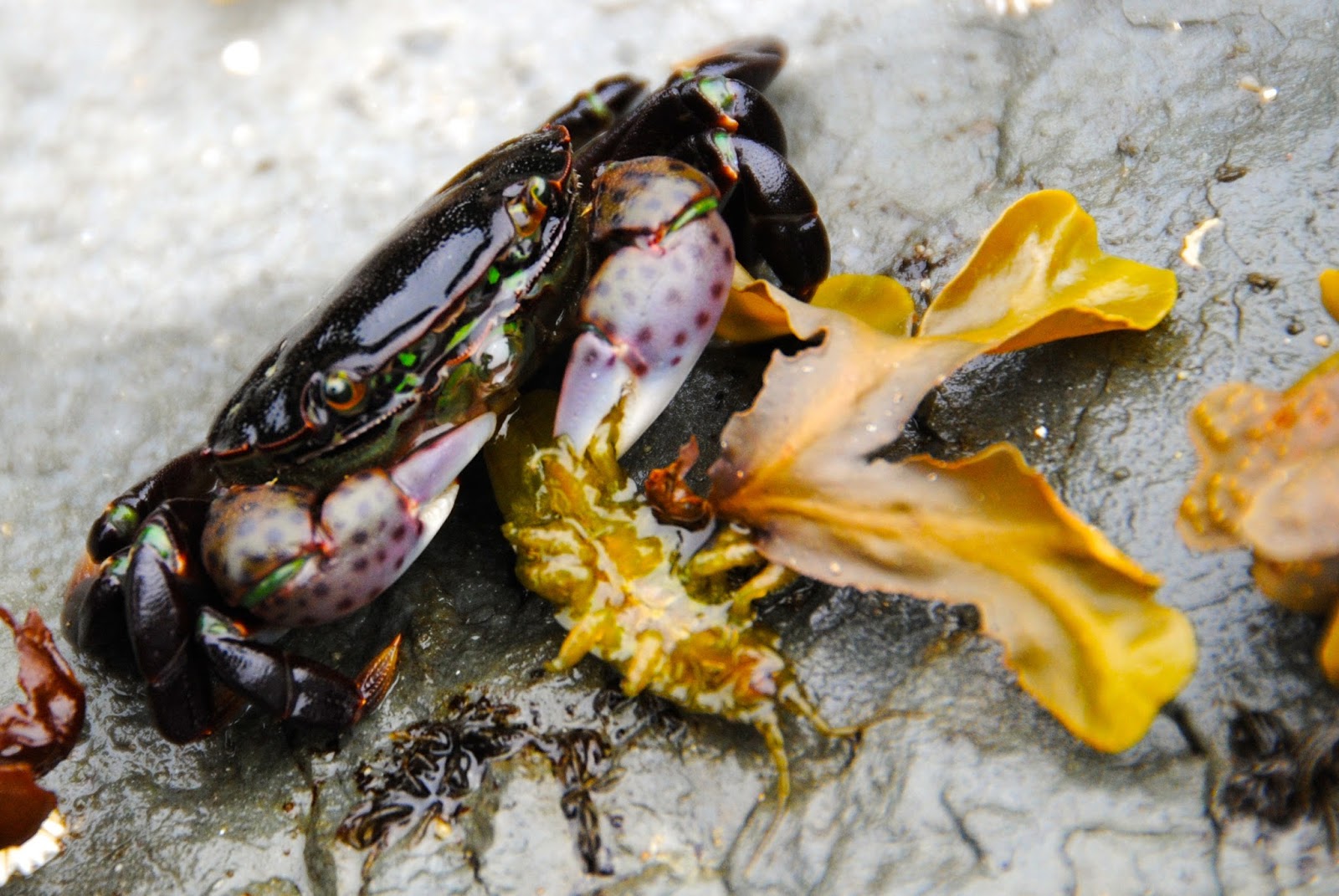
| A shore crab eats a hapless kelp isopod. |
 |
| Just read on below to find out what happened here. |
 |
| Coraline algae grows in the tide pools of the limestone shelves. |
 |
| A pair of harbour seals relax among the kelp at low tide. |
 |
| Nothing like a pleasant afternoon ride in a cable car. |
 |
| One of many cable cars. Yes, the river really was that green. |
 |
| Now its my turn to go up. |
Afternoon
 |
Crooked, rotting, and gaping with holes,
I thought this boardwalk looked like it
was in rough shape. I know different
now. |
 |
Longer ladders than day one, but still
unimpressive. |
The rugged shelf of rock appeared vast and empty in the hazy sunlight. A pair of lazy seals,
Phoca vitulina, turned over on the rock and one snorted in boredom, momentarily breaking the silence. But it wasn't silent. Quietly, at least to human ears, a host of smaller creatures were sputtering and bubbling in the drama of their intertidal lives. Mussels coughed in the struggle of exposure and barnacles creaked on their hinges to trap in the remaining moisture. An isopod,
Idotea wosnesenskii, crawled lethargically across the open sandstone. Green and red algae lay just ahead but the small crustacean was running out of strength and energy. Around it, shore crabs,
Hemigrapsus nudus, could sense the isopod's stress. Unable to keep moving, its compound eyes could sense a crab approaching. Normally the small purple crabs would feed on barnacles in the intertidal but they are notoriously opportunistic. The isopod attempted to move but its struggles only seemed to draw attention from the scavengers. Suddenly, a small crab has one of the isopod's legs but its energy is spent. It looked like things were about to get very ugly for the isopod when suddenly the small grey crab fled for a crack in the rocks. But it was not the isopod's liberation. A giant purple shore crab, with yellow spots patterning an impressive set of powerful chelipeds. In a swift grappling motion the isopod was crushed and the crab began to feed on the leaking juices. The intertidal is full of dramas that we, as large terrestrial vertebrates, seldom notice.
 |
| The northwestern garter snake, Thamnophis ordinoides. This was the first snake we spotted on the trail. |
 |
| Dad looks a little precarious at the edge of the Pacific precipice. |
 |
| That's better. |
 |
| Sometimes the sandstone shelves of the west coast are broken and eroded into isolated rocks of intertidal life amid a substrate of sand, like ancient men standing in the ashes of the deceased. |
 |
| The giant swells of the open Pacific rise, unhindered from the deep, submerging and draining from large coastal shelves of sandstone. |
 |
| The rugged coastline is a mix of boulders, gravel and sand beaches, and sandstone shelves. |
 |
| We are nearing the hole in the wall, visible from the cliff tops. |
 |
| Gray whales frequent the shores of the West Coast Trail, especially the northern portions. One hiker informed us that he had seen orcas and another stated that the killer whales had been "playing" with the grey whales. |
 |
| The stairs down to Tsusiat. |
Evening
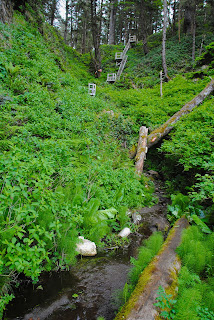 |
| The trail to the Tsusiat campground. |
Beneath the rushing waters of the Tsusiat Falls, were the cascade falls into the pool at its base sending a spray of shimmering droplets into the cloudy skies, a young bird waited patiently. He was a plump little bird of about 10 centimetres long with dark gray, uniform plumage. Dripping wet in the mist from the falls, he looked more like a sewer rat than a bird. His short stubby tail revealed his immaturity; a dipper,
Cinclus mexicanus, hatched from a riverside nest early in the spring. He looked alone dripping under the falls but he had learned to be patient. In the meantime, practice was essential. He dropped his tail and bent his knees. A dip, for the namesake. It looks like a little dance, as the bird bobs up and down at the waters edge. He also eyed the water, even wading a little. Soon he'd be able to dive for his food, aquatic insects but, right now, mother does all that. She soon arrived, announcing successful hunting with a chattering. He responded with a pathetic peeping, pleading for the meal that he waited so patiently for. The adult jammed her beak into his throat and darted off to find second helpings. It was over so fast, the fledgling probably didn't even taste it.
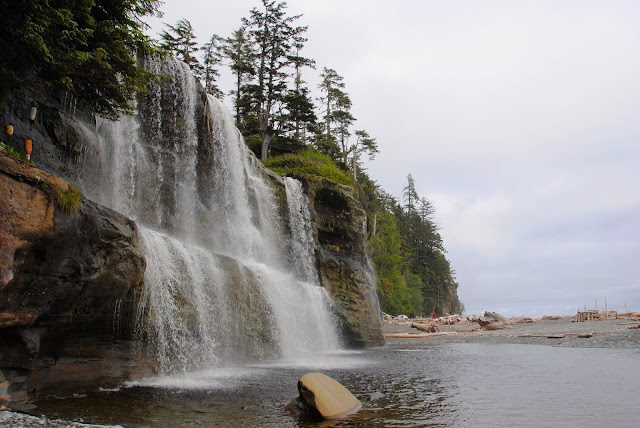 |
| Tsusiat Falls, with the campground in the background. |
 |
| A juvenile dipper waiting under the falls. Dippers nest on cliffs, sometimes even beneath powerful waterfalls. |
 |
| Otter tracks around the falls indicated that the large, aquatic mustelids frequent this area when people aren't watching. |