Pages

Showing posts with label Pachydiplax. Show all posts

Friday, 9 January 2015

Search for the Painted Turtle: Part III

After two failed searches for the painted turtle north of Courtenay, I decided to move farther south. A local wildlife photographer showed me a picture a friend of his took of several painted turtles near Port Alberni. My Dad and I decided to turn it into a camping trip. We spent nights at Stamp River Provincial Park and days around Turtle Lake and proximal bodies of water. Male Pachydiplax longipennis. Turtle Lake, near Port Alberni, Vancouver Island, British Columbia. July 31, 2009. Canon PowerShot A430. ISO 200, 5.4mm, 0EV, f/5.6, 1/400.


The dragonfly diversity at turtle lake was great. This is a male blue dasher. Unfortunately, the closest wing (out of focus) was broken. I literally posed him for this photo. Male Pachydiplax longipennis. Turtle Lake, near Port Alberni, Vancouver Island, British Columbia. July 31, 2009. Canon PowerShot A430. ISO 200, 5.4mm, 0EV, f/5.6, 1/640.
A Crimson-winged whiteface. The females are yellow. Male Leucorrhinia glacialis. Turtle Lake, near Port Alberni, Vancouver Island, British Columbia. July 31, 2009. Canon PowerShot A430. ISO 200, 5.4mm, 0 EV, f/2.8, 1/25.

Once again, I think we have another hybrid here. If you've read my other posts, that seems to happen quite often. The brown tint seems to indicate that this guy is the progeny of both common and northwestern garter snake parents but it might just be an allusion because the roads are very dusty around the slough and he is probably due for another shed soon. Thamnophis sirtalis pickeringii. Slough near Turtle Lake, near Port Alberni, Vancouver Island, British Columbia. August 1, 2009. Canon PowerShot A430. ISO 200, 5.4mm, 0 EV, f/2.8, 1/80.

Bladderworts are nifty plants. This is just the flower, protruding above the surface of the water, but, beneath the layers of watershield, this is a filamentous aquatic plant. They are called bladderworts because, along the aquatic stems, there are a number of little watertight bladders. They are lined with tiny, sensitive hairs that, when triggered by the movement of some unfortunate insect larvae, spring the bladder open, causing a sudden inflow of water. It sucks the insect right in and promptly seals off the escape. The bug decays and is digested. Yes, the bladderwort is a carnivore. In a strange twist of irony, this one is infested with aphids, feeding on the plant's stem. Utricularia vulgaris flowers with Brasenia schreberi leaves behind. Slough near Turtle Lake, near Port Alberni, Vancouver Island, British Columbia. August 1, 2009. Canon PowerShot A430. ISO 200, 5.4mm, 0 EV, f/2.8, 1/640.
In conclusion, we did find the turtle. It was a mile away at the backside of the slough. No pictures. When it saw us looking in its general direction, it slipped away. I certainly wasn't satisfied with this "success." We were sunburnt and hot; it had been over 30 degrees Celsius every day of the trip. We did swim in the cool Stamp River evenings, but it was little consolation. I kept the elusive painted turtle in the back of my mind for another two years. My Dad and I tried a Victoria trip in search of turtles but without any luck. The locals told us that they used to live in the lakes, but since the invasive water mill foil and bullfrog choked out every other living thing in the lakes and houses line every shoreline, the turtles not only had nowhere to swim or breed, they were being replaced. I gave up on finding the elusive painted turtle. On a work trip with Crossland Sheds, I finally caught my first western painted turtle (Chrysemys picta bellii) at Swan Lake in inner city Victoria (Saanich). It was fitted with a radio transmitter and out of the water--an easy catch. It was clearly a female, looking for a place to lay eggs, so I let her go promptly. The transmitter means that there are researchers studying the turtles in Victoria, which is good. But there future is far from certain. Every viable egg laying site at the lakes I visited had been developed. It's not surprising that the single wild turtle I did see at Port Alberni was a large, old female. There is no next generation for the western painted turtle. It has faded out of sight and out of mind for locals on Vancouver Island and, a turtle that once had a range as far north as Campbell River, is now isolated in a single, heavily monitored population in inner city Victoria. I'm sorry to say, my search for the painted turtle doesn't have a happy ending. The picture above is my father, ever the epitome of outdoorsman-ship. Slough near Turtle Lake, near Port Alberni, Vancouver Island, British Columbia. August 1, 2009. Canon PowerShot A430. ISO 0, 5.4mm, 0 EV, f/5.6, 1/400.

Friday, 12 July 2013

Dragonfly Design

I almost feel bad posting on an insect that has received so much publicity, but I think I can come at it from a refreshing perspective. For starters, dragonflies are often considered flying creatures so, although they certainly seem to be a "creeping" sort today, they may have been created on day 5 of the creation week with the other flying animals (see Genesis chapter 1). However, dragonflies actually spend the majority of their lives underwater so perhaps they are better considered "swimming creatures." Some species can hunt on land (Grzimek, 1975), however, so perhaps the original kinds behaved this way, given that the world might have been more moist before the global flood. From that original kind came a menagerie of different species diversifying to fill the various ecological niches available to them. Those that found themselves in the Carboniferous forests grew huge, larger than many of today's hawk species. Damselflies, though superficially similar to dragonflies, do not share a common ancestor, I believe. This becomes apparent when one views the two kinds when they are in their aquatic nymph stage. Damselflies have large featherlike protrusions from their abdomen.
When one thinks of dragonflies, they typically envision a four winged, predatory insect of the air. The truth is, dragonflies are more of an aquatic species (as was mentioned above). They may spend up to five years as an aquatic nymph, breathing with gills (Dreves, 1993). They are amazingly well designed for this aquatic life cycle, doing anything a dragonfly would do except for breeding. To escape predators (like giant diving beetles or aquatic salamanders) they even have a system of jet-propulsion in which water is forced out the anus of the dragonfly (Mill et Pickard, 1975).
The mature dragonfly only lives a few weeks to several months, though this is when we commonly notice them. Not only are they simply obvious flying around any body of water, they are also brilliantly coloured during this stage.
Even as adults, dragonflies are amazingly well suited to life on the wing. They have four wings, each of which can manoeuvre independently of the others to propel the insect in whichever way it choses (up, down, sideways, backwards, you name it). While we might be inclined to think that our own eyes are the superior system for vision, they would hinder the dragonfly on his mission. With large compound eyes and a swivelling head, the dragonfly can see nearly 360 degrees of its surroundings (Dreves, 1993). The tens of thousands of lenses on these eyes are far better at picking up movement than simple eyes and can see a mosquito 40 meters away (Dreves, 1993), which is the equivalent of us seeing a mouse 1.5 kilometres away.
Catching prey can be difficult. Mosquitoes are relatively easy, flying a meagre top speed of 2 kilometres per hour. The average dragonfly at 29 kilometres an hour has no difficulty catching hundreds of mosquitoes in a day. Horseflies are more difficult, however, with an astonishing top speed of 145 kilometres per hour (speedofanimals.com). The great British-Australian naturalist Robin Tillyard claimed to have clocked a southern giant darner at 97 kilometres per hour (Tillyard, 1917), but even this debated number wouldn't be enough to catch a speeding horsefly (50 kilometres is considered a better estimate of top speed). Maneuverability and planning are the key to the dragonfly's success.
People have always been fascinated by the amazing designs of the dragonfly and the military often attempts to copy the design in their own fighter jets. Engineer Stuart Burgess recently wrote on the way that engineers are copying the dragonflies four-winged design for their own micro air vehicles (Burgess, 2012).
In order to do all this brainy hunting, dragonflies need to warm up every morning. They are cold blooded and need sunlight to give them the copious amounts of energy they will need. Once again,the intelligence of the dragonfly comes into play. To heat up as quickly as possibly, they tilt their wings and body to catch as much of the sun's rays as possible. As the day gets hotter, and the dragonfly feels a need to cool off, it will tilt its body to absorb as little of the suns rays as possible. Doing this allows the dragonfly to maintain a constant temperature throughout the day.


References:


Burgess, Stuart. 2012. “Bug Bots”. Answers. Vol. 7, No. 1. Jan-Mar 2012. Answers in Genesis—USA.

Dreves, Denis. 1993. “Dragonflies: Designed to Dart”. Creation. Vol. 16, Issue 1. December 1993. Creation Ministries International.

Grzimeck, HC; Bernhard. 1975. Grzimeck’s Animal Life Encyclopedia Volume 22. Visible Inc Press. Detroit. Page 348.

Mill, P. J. and R. S. Pickard. 1975. “Jet-propulsion in Anisopteran Dragonfly Larvae”. Journal of Comparative Physiology A: Neuroetholoy, Sensory, Neural, and Behavioral Physiology. Vol. 97, No. 4. Pages 329-338. http://link.springer.com/article/10.1007%2FBF00631969

Tillyard, Robert John. 1917. The Biology of Dragonflies. University Press, Cambridge.
Thursday, 25 April 2013

Tarkiln Bayou Preserve State Park

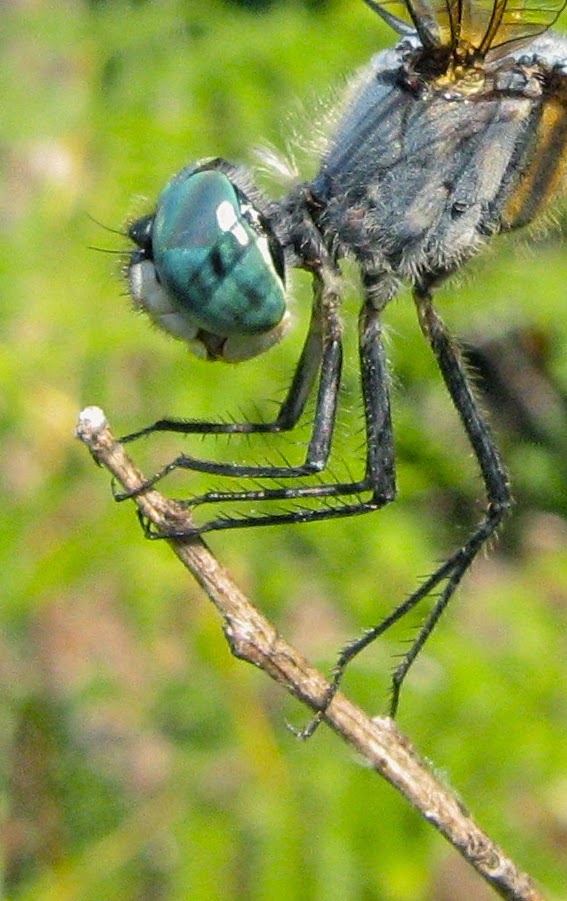
This is a species of pennant dragonfly I think. Any help on the identification of the insects on this post (or others) would be greatly appreciated. 
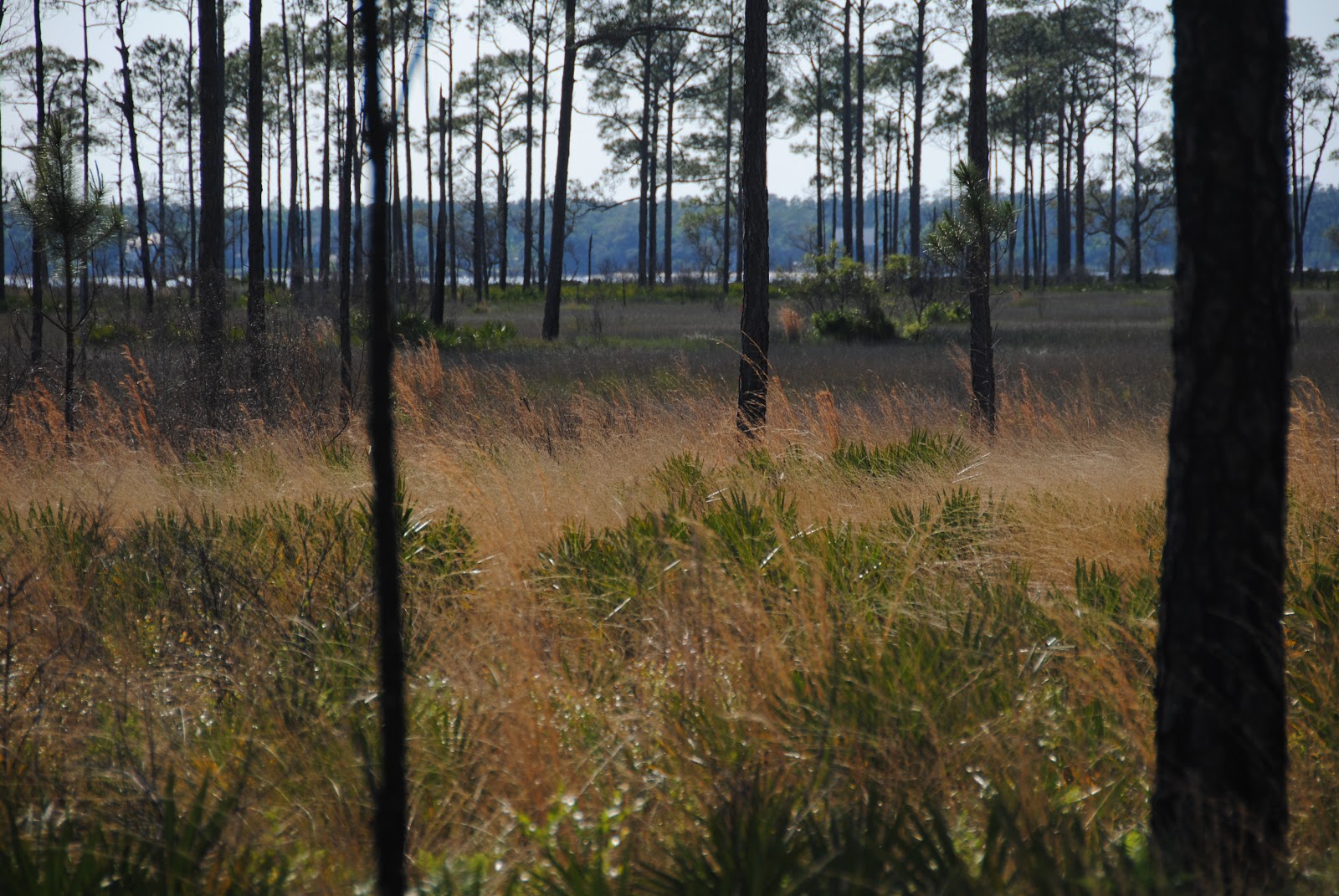
My brother in the pine flatwoods of
the park.
I have no idea what kind of spider
this is. They are big; over an inch
 in diameter (including the legs).
I thought nothing of it at the time. I knew there where wild pigs in the park, and I also knew they could be aggressive. But I always wandered away from the guys, veering off the trail and encountering creatures that none of the others would ever know about. I didn't expect to encounter anything so shocking. Then I heard it. A shuffling noise in the undergrowth. I stepped into that strip of land between the beach and the trail, but it was to thick to make out what was rustling. Then it squealed. Like a boar in a tussle with another, it squealed. At first I was apprehensive and stepped back. But my enthusiasm for wildlife consumed me and I pulled out my camera. Then they started really rustling, moving about in the thicket. Sounded like a whole herd, and I couldn't tell which way they were going. Fearing a charge, I called to the others, "Wild pigs! Wild pigs!" I continued to bellow emphatically as I moved toward the noises until it spoke. "Umm...actually, it's just a man in here." Some poor bloke had been trying to take a dump off the beach and there I was standing in front of him with a camera. I don't know who was more embarrassed. "I could have sworn you were a wild pig!" I exclaimed. He sure sounded like one! The poor man just mumbled and made his way back out to the beach. How embarrassing!


Oak toad on the white sands of Florida's trails.
This is the salt marsh that runs between the flatwoods and the bay. Tarkiln Bayou is so near geographically to West Campus that it reminded me of places since destroyed.

This is meadow where I first spotted
 the cottonmouth. I see them on
 every hike in Florida it seems.
The spanish moss grows thick.
Besides wild pigs I caught a common garter snake and nearly had a cottonmouth, but it moved into thick bush. At first I crawled in after it with snake tongs in hand, but visibility was so limited in that dark thicket and it struck me that, if I did find the snake, I would be to close. Army-crawling through the bush like I was, it would have bit me right on the face if it saw fit. Needless to say, I decided not to pursue. The hike came out to about 8 miles and covered sections of pine flatwoods, salt marsh, and white-sand beachfront.
Six-lined racerunner.
Toothpick grasshopper.
The two most common creatures in the flatwoods that I encountered (besides cricket frogs) where oak toads and six lined racerunners. I also encountered leopard frogs and plenty of dragonflies and damselflies. The six lined racerunners are a joy to try and catch. It's humanly impossible to do so, I'm convinced. The three of us had one cornered on many an occasion. At one point we thought for sure we had it. Luke threw the net down and, as far as anyone could see, the lizard was under there. I thought I saw something flash over the horizon, but I didn't think it was the lizard at the time. It must have been because that net was empty. So fast our eyes couldn't even pick it up.
Wasp attacking caterpillar.
I might as well have out with it. I am a camouflage fanatic. One of the best examples of this in florida is the toothpick grasshopper. It looks just like some little twig (or a toothpick, he, he). They are very common in many of the areas I was at in Florida including West Campus. And no wonder! If they didn't move, a predator might never spot them. However, it seems that have sacrificed some of the energy and agility that the other grasshoppers possess to diversify into such a perfect camouflage. It's worth it though, since there are so many of them around. And I can't help but wonder how many I never even noticed. A whole lot, I'll warrant. Many other grasshoppers were seen as well, but I didn't photograph any of them. It's kind of sad, but all the most common usual species are usually neglected by my lens.
Brown pelican. Proud parent.
INCOMING!!
Another insect encountered was a sort of paper wasp. One of the ones my friend Luke spotted was devouring a small caterpillar, mashing up it's head into a pulp and slurping up the guts and fluid. A lot of people are not aware of the predatory nature of wasps. We tend to picture them ruining picnics or pollinating wildflowers (which they seldom do). The truth is, wasps are one of the top predators to many creatures, including caterpillars. In fact, some species feed almost exclusively on caterpillars. It reminds me of a time when I was out door-knocking. Under the porch light was a little hole. I watched with much amusement as a wasp arrived with a paralyzed caterpillar and stuffed it into the hole. I imagine that the hole was full of such caterpillars, all paralyzed, waiting for the egg, laid on the back of one of them, to hatch. Then the little grub would begin to devour it's pre-stored food. I'd seen such things on David Attenborough's shows but it was a delight to see the real thing for myself. It is a good example of a caring parent in the insect world. To bad insects are often viewed in such a negative light.

Along the shoreline, I saw a number of birds training or protecting their young. A killdeer was seen first and, classically, it led me away from its mate and nest. It didn't call much but its mate back at the nest, called repeatedly. Unless it was the young in a nest. But judging from where those sounds were coming from, the nest would have had to have been in a tree. Not likely for killdeer.
Further along, I encountered a pelican wheeling and soaring around a patch of coast with its youngster close behind following her every move. It was amazing to see a dedicated parent showing her adolescent how to curve and move in the air. It must be quite an achievement to fly when you're a pelican, especially considering that great big head. Good thing it's as light as bird bone!
Well, that's about the longest post I've ever made! Glad it's over. Next time I'll do it in two parts!
Look at those dudes.