![]() |
| A young six-lined racerunner makes the most of the fringes of the burn. Bugs are easy to spot out here. |
Showing posts with label Tarkiln Bayou Preserve State Park. Show all posts
Saturday, 20 August 2016
Fire Ecology at Tarkiln Bayou - May 14
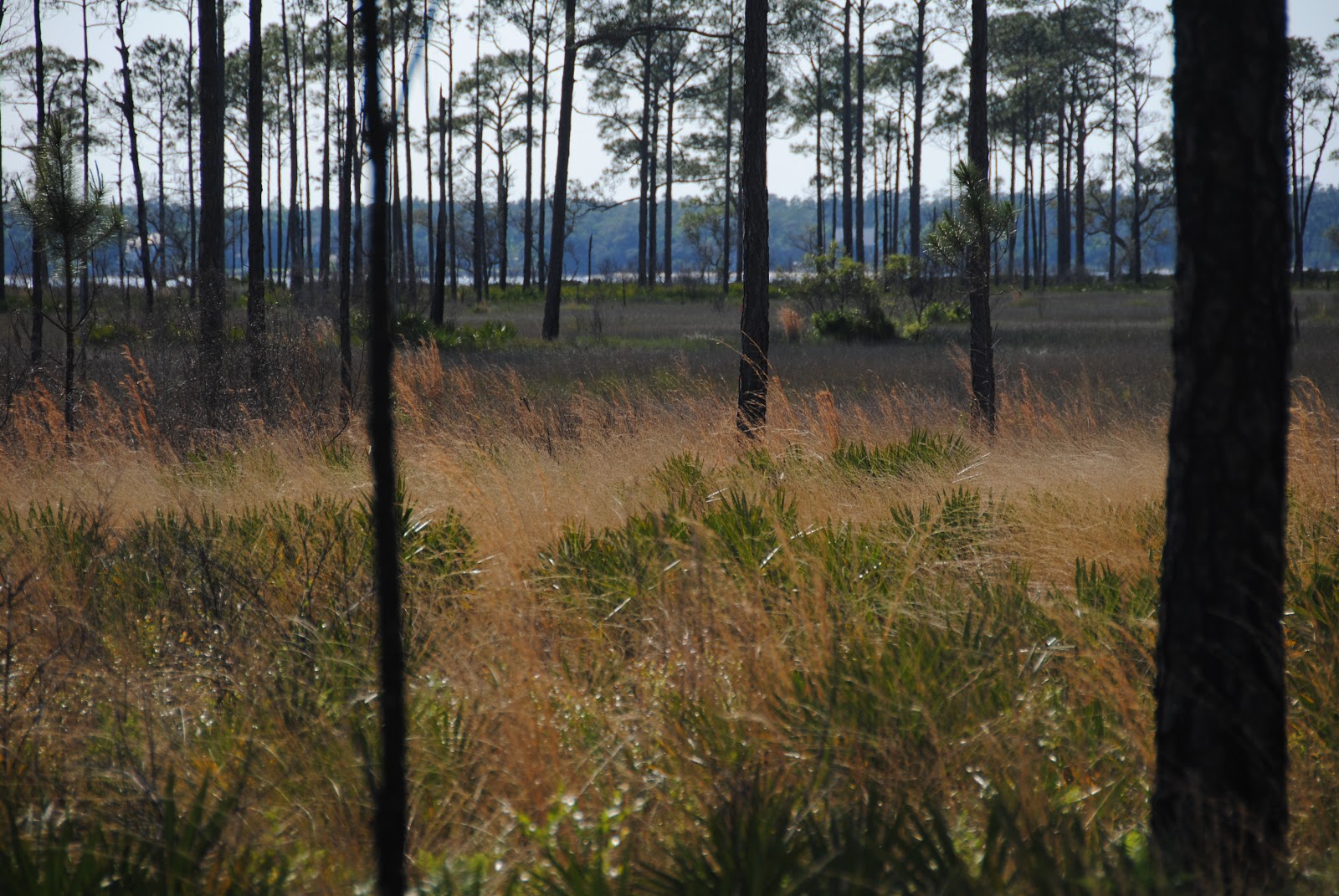
Back in May I went out to see some of the aftermath of a controlled burn at Tarkiln Bayou Preserve State Park. Here are some of the shots.
Saturday, 16 January 2016
Sketches at Tarkiln Bayou
![]() |
| Detail from my sketch pad. This is supposed to portray the setting sun. |
However, sketching is a much slower process. A photographer can rush through the underbrush, snapping away at whatever catches his or her fancy. A sketcher, by comparison, must sit in one place and carefully attempt to reproduce some small aspect or picture of the environment onto paper. This slower pace forces the sketcher to notice things that the photographer often misses. The shapes of the leaves and stems of plants become more interesting than the flowers. The silence of immobility sharpens underused senses. The salty smell of the bayou. The wailing of a family of loons. A sudden splash from a jumping mullet. These things become the focus--and how to portray them in art. A quiet yet lively mood, all on paper.
![]() |
| Sketch of the eastern shoreline of Tarkiln Bayou |
![]() |
| Sketches of a stump in the water. |
![]() |
| Sketches of water and plants at Tarkiln Bayou. |
Friday, 9 October 2015
Herping after Dark in the Florida Panhandle
Here's a post from someone you haven't heard recently. I've been busy--very busy. It is not unusual for me to work 14 hours in a day and 9 hours is a short one. I worked hard this week and managed to keep up with all the homework and quiz grading common in the life of a college biology teacher. At the end of the day I rolled out of work at 4:00pm. Nine hours. After a quick dinner and an episode of John Acorn's Nature Nut show I grabbed my Nikon and a minnow trap and danced out the door.
Sometimes I have to schedule my moments of enjoyment just as religiously as my work and education. I'd been planning a trip out to set my minnow trap for a couple weeks and a Friday night seemed like a good time to me. However, my graduate class was hanging over my head as I pulled from the campus and I'm hoping I don't regret my choice of activity for the night. Good grades are encouraging but it's no excuse to procrastinate.
I had hoped to set a minnow trap at Tarkiln Bayou but that is a state park and I imagine it would be less than legal to remove any fish or wildlife from the park. However, I couldn't think of anywhere else to go. Whenever I have questions about the local wildlife I always find my way to Mr. Micah Bowman's office. A tall, lanky man with relaxed enthusiasm for zoology, Mr. Bowman spent his childhood in the panhandle and is far more adept at finding cool critters than I could ever hope to be. I asked my fellow faculty member if there were any places he could recommend for a minnow trap. His answer, always nonchalant, was so obvious I was embarrassed. West Campus was college property and fishing was encouraged.
Yes, they are cannibals. My aquarium has three turtles at the present so trying to put some fish in there might be a bad idea. Sunfish would be nice but I find the predatory pickerel completely fascinating. I pulled the trap from the back of my minivan and made the short jaunt to the slough.
As I approached the rickety bridge over the algae-choked waters I spotted a black disk lying in the grass. It was just passed 7pm and the battery was low on my headlamp. I had to get close to see that it was a small cottonmouth snake (Agkistrodon piscivorus). Cottonmouths have a highly hemolytic venom that causes blood cells to rupture and tissues to break down, practically rotting off. However, I was delighted. In my excitement I ran back to my van to grab my ever-handy snake tongs and returned to where I'd dropped my trap before long. The snake was still there and I caught the snake without too much of a fuss. One strike and some degree of warning. It amazes me how placid these potentially lethal snakes are. This one seemed to have an especially calm disposition. The characteristic wide-open mouth display is an obvious message to threats. I carried the snake to the beach and took a few photos on the sand. Delightful.
Pumped with herpetological enthusiasm, I released the snake and started searching for more reptiles and amphibians with my headlamp. A southern toad (Bufo terrestris) hopped out of my way and soon I was running around the grass giggling like a four year old catching frogs.
In the end I threw my trap over the bridge and watched it sink to the bottom. I tied the knot and headed back to my van. It was a good time and I don't regret it yet.
Sometimes I have to schedule my moments of enjoyment just as religiously as my work and education. I'd been planning a trip out to set my minnow trap for a couple weeks and a Friday night seemed like a good time to me. However, my graduate class was hanging over my head as I pulled from the campus and I'm hoping I don't regret my choice of activity for the night. Good grades are encouraging but it's no excuse to procrastinate.
I had hoped to set a minnow trap at Tarkiln Bayou but that is a state park and I imagine it would be less than legal to remove any fish or wildlife from the park. However, I couldn't think of anywhere else to go. Whenever I have questions about the local wildlife I always find my way to Mr. Micah Bowman's office. A tall, lanky man with relaxed enthusiasm for zoology, Mr. Bowman spent his childhood in the panhandle and is far more adept at finding cool critters than I could ever hope to be. I asked my fellow faculty member if there were any places he could recommend for a minnow trap. His answer, always nonchalant, was so obvious I was embarrassed. West Campus was college property and fishing was encouraged.
| I nailed these photos of a grass pickerel (Esox americanus) at Tarkiln Bayou last year (2014) near the end of November. I have been hoping to get a couple for my 120 gallon aquarium back home. |
Yes, they are cannibals. My aquarium has three turtles at the present so trying to put some fish in there might be a bad idea. Sunfish would be nice but I find the predatory pickerel completely fascinating. I pulled the trap from the back of my minivan and made the short jaunt to the slough.
As I approached the rickety bridge over the algae-choked waters I spotted a black disk lying in the grass. It was just passed 7pm and the battery was low on my headlamp. I had to get close to see that it was a small cottonmouth snake (Agkistrodon piscivorus). Cottonmouths have a highly hemolytic venom that causes blood cells to rupture and tissues to break down, practically rotting off. However, I was delighted. In my excitement I ran back to my van to grab my ever-handy snake tongs and returned to where I'd dropped my trap before long. The snake was still there and I caught the snake without too much of a fuss. One strike and some degree of warning. It amazes me how placid these potentially lethal snakes are. This one seemed to have an especially calm disposition. The characteristic wide-open mouth display is an obvious message to threats. I carried the snake to the beach and took a few photos on the sand. Delightful.
Pumped with herpetological enthusiasm, I released the snake and started searching for more reptiles and amphibians with my headlamp. A southern toad (Bufo terrestris) hopped out of my way and soon I was running around the grass giggling like a four year old catching frogs.
![]() |
| Rana sphenocephala, the leopard frog. Loads of fun chasing these guys through the grass and catching them. |
In the end I threw my trap over the bridge and watched it sink to the bottom. I tied the knot and headed back to my van. It was a good time and I don't regret it yet.
Friday, 9 May 2014
A Biblical View of the Animal World
While at college, I was asked, as a part of my zoology class, to choose five Bible verses that I believed were crucial to a Biblical understanding of animals and write about my the reasons I chose those verses. Here is what I came up with:
Genesis 1:28
And God blessed
them and God said unto them, Be fruitful, and multiply, and replenish the
earth, and subdue it: and have dominion over the fish of the sea, and over the
fowl of the air, and over every living thing that moveth upon the earth.
Genesis 3:14
And the Lord God
said unto the serpent, Because thou hast done this, thou art cursed above all
cattle, and above every beast of the field; upon they belly shalt thou go, and
dust shalt thou eat all the days of they life:
Leviticus 11:46
This is the law
of the beasts, and of the fowl, and of every living creature that moveth in the
waters, and of every creature that creepeth upon the earth:
Psalm 147:9
He giveth to the
beast his food, and to the young ravens which cry.
Matthew 6:26
Behold the fowls
of the air: for they sow not, neither do they reap, nor gather into barns; yet
your heavenly Father feedeth them. Are ye not much better than they?
The
twenty-eighth verse of the first chapter of Genesis records God’s first command
to mankind: Fill the Earth and rule over the animals. Often Christians are
tempted to conclude that this dominion is a license to exploit and use for our
own personal enjoyment and pleasure. The reason so many acquire this
perspective is found in verse six of chapter three. We seldom give thought to
what we would consider a good ruler, someone who looks out for the interests of
his subjects. Verse fourteen of chapter three records what is often incorrectly
stated as a curse on a snake, thus giving excuse for men to abuse this
amazingly designed creature on the premise that it was “cursed of God.” Simply
reading the verse reveals that this cannot be the case; it would eat dust, and
no snakes do that. Also, nowhere is it mentioned that the cursed creature would
loose its legs. Indeed the phrase “upon thy belly thou shalt go” caries the
idea of crawling, not slithering, which requires legs. It is to bad that it
does not occur to most people that the word translated “serpent” is also
translated as “dragon” in other parts of the Old Testament. It is not
surprising then that Satan is referred to as a dragon in Revelation.
Additionally, the context of the verse reveals that this is, in fact, a curse
on Satan prophesying of Christ’s coming. So there is no Biblical excuse for
women or anyone else to treat snakes with contempt. In Leviticus, chapter 11 a
list of animals is given and the clean ones are stated as being “living.” This
word in Hebrew is nephesh and caries
the idea of a soul-life. Such nephesh
living things are treated with more respect than other living things such as
plants, which are merely described as “withering” rather than truly dying in
the Bible. Interestingly, the list in Leviticus includes insects (verse
twenty-two). Thus, in a Biblical perspective of life, to kill a grasshopper is
equivalent to killing a horse. Finally, verses in Matthew chapter six and Psalm
147, in verse nine, record that God himself takes interest in and cares for the
needs of animals. It is indeed a comfort to Christians that God loves us so
much (as is the thrust of the Matthew verses) but many people miss the fact
that God takes interest in the death of even a common bird sold at the market. Christians,
likewise, should take their God-given responsibility to watch over God’s
creatures seriously.
Thursday, 25 April 2013
Tarkiln Bayou Preserve State Park
| This is a species of pennant dragonfly I think. Any help on the identification of the insects on this post (or others) would be greatly appreciated. |
| My brother in the pine flatwoods of the park. |
![]() |
| I have no idea what kind of spider this is. They are big; over an inch in diameter (including the legs). |
| Oak toad on the white sands of Florida's trails. |
| This is the salt marsh that runs between the flatwoods and the bay. Tarkiln Bayou is so near geographically to West Campus that it reminded me of places since destroyed. |
| This is meadow where I first spotted the cottonmouth. I see them on every hike in Florida it seems. |
| The spanish moss grows thick. |
| Six-lined racerunner. |
| Toothpick grasshopper. |
The two most common creatures in the flatwoods that I encountered (besides cricket frogs) where oak toads and six lined racerunners. I also encountered leopard frogs and plenty of dragonflies and damselflies. The six lined racerunners are a joy to try and catch. It's humanly impossible to do so, I'm convinced. The three of us had one cornered on many an occasion. At one point we thought for sure we had it. Luke threw the net down and, as far as anyone could see, the lizard was under there. I thought I saw something flash over the horizon, but I didn't think it was the lizard at the time. It must have been because that net was empty. So fast our eyes couldn't even pick it up.![]() |
| Wasp attacking caterpillar. |
| Brown pelican. Proud parent. |
| INCOMING!! |
Well, that's about the longest post I've ever made! Glad it's over. Next time I'll do it in two parts!
| Look at those dudes. |
Subscribe to:
Posts (Atom)