Pages

Showing posts with label photography. Show all posts

Saturday, 7 January 2017

Life on Mount Washington

August 17, 2016

This little guy was begging us for food. Juvenile grey jays, like this one, may never develop the ability to find food for themselves if they get handouts from humans. When winter rolls around, he may starve.
Mount Washington is home to an alpine resort, ski village, mountain biking club, hiking trails, and many other tourist attractions. So, needless to say, the challenges faced by wildlife and vegetation are usually rooted in human causes.
Vegetation has a particularly challenging prospect. The face of the mountain may be criss-crossed by ski trails, chair lifts, and hiking paths, but crowds of people still feel the urge to tromp out of bounds. The authorities do their best to keep the folks on the trails but the imagination of many people dictates that they pursue the better view through the underbrush.
Colorful lichens grow on the rocks by the trail. They are often the first organisms to colonize mountainous habitats so, when an area is disturbed (such as a trail), they may cling on when other forms of vegetation have been vanquished.
Animals also have to cope with human influences and some are all to eager to take advantage of our sentiments. Possibly the most famous example of animal-human interactions is that involving food. On Mount Washington, the grey jay is the primary offender. This small bird is so accustomed to human handouts it will even land on outstretched limbs, provided there is a snack in the palm. Like deviating from the trail, a close encounter with a mountain bird is nearly impossible to resist. Of course, the birds don't really benefit from being fed. For starters, junk food isn't healthy for anyone. Second, when the juvenile birds become addicted to the human trash, they won't know what to do with themselves when winter rolls around. In other words, feeding the birds, eliminates their ability to fend for themselves. They never learn. As a result, populations of grey jays have actually declined because youngsters aren't surviving the winter.
A western meadow fritillary warms itself on the grey stones lining the paths on Mount Washington. The insects on the mountain generally avoid people, but we did encounter a nest of small wasps that swarmed anyone who stood too long on the boardwalk overlooking the Forbidden Plateau. Fortunately, they were too small to cause people any discomfort.
On the other hand, people learn to love the things they can touch. A bird landing on a child's hand is a very positive interaction with nature for a kid. It teaches him to love nature and that may be more important than that particular bird's ability to survive. Every kid that grows up loving wildlife is a victory for nature.
A grey jay junky casts a hopeful glance in my direction.

The View from Mount Washington

August 17, 2016

I may have gotten a little carried away with panoramas.
I'm aware there are multiple mountains in the world that have been named Mount Washington. The one that I visited this summer was on Vancouver Island, off the west coast of British Columbia. Mount Washington was name, so they say, because from the east coast of the Island, it looks like the skyward facing silhouette of President George Washington's face. Enjoy these photos from my trip up the mountain with my parents during my brief time back home.

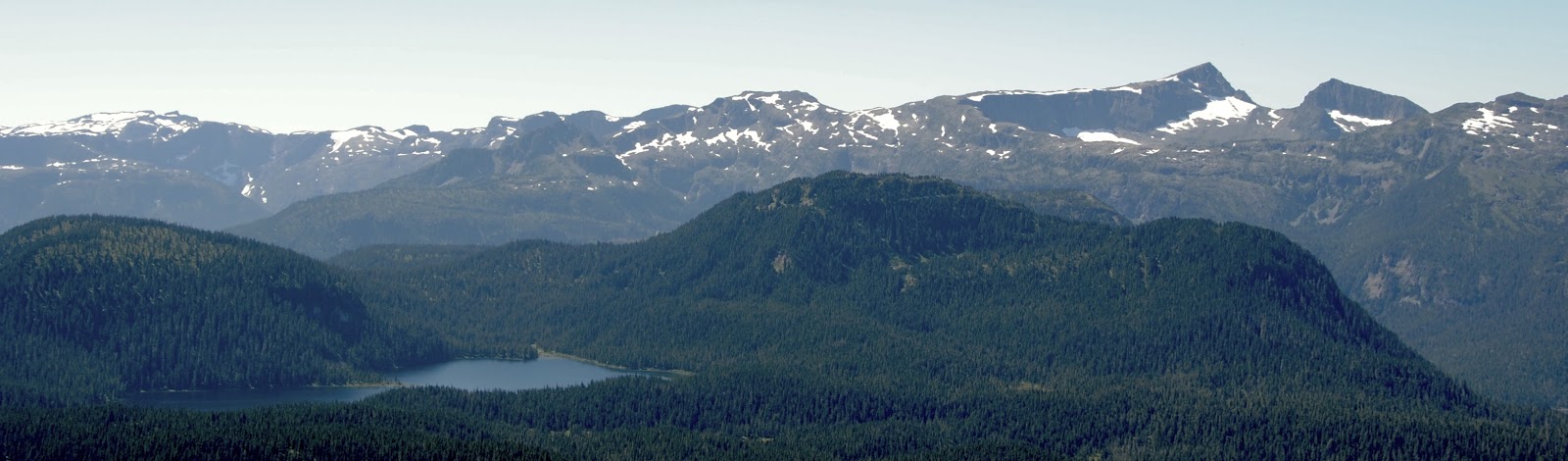
Vancouver Island is riddled with lakes. Below, the Forbidden Plateau rolls out as green mounds of trees beneath the brown backbone of the Island.
Some ponds way down in Forbidden Plateau.
To the south, another set of high-rising hills pushes through the coastal plateau.
Another panorama of Vancouver Island backbone and the lakes of Forbidden Plateau.

Friday, 30 December 2016

Sunset in the Canadian Rockies

August 2, 2016

The foreground of the photo has an interesting blur to it that I actually appreciate. Who could have guess that sunsets looked better out of a moving vehicle.
Taking photographs out of a moving vehicle can be a challenge. However, in some cases, unique photography opportunities like these create foreground blurring that proves to be aesthetically pleasing. These two photos were taken in Yoho National Park as we hurriedly approached our campground at Lake Louise, Banff National Park.

I decided not to crop this photo in. The hazy greys of the dusky sky produced a feeling more reflective of the Rocky Mountain thunderstorm that had just passed through. When this photo was taken, the roads were still wet.

Tuesday, 27 December 2016

Invasive Species and Anole Microhabitats

October 8, 2016

A chubby little green anole glances nervously over its shoulder at my camera.
Protected since 1974, the Pascagoula River is the largest free-flowing river in the lower 48-- free of man-made damming. However, it is certainly not free of other human influences. Inevitably, invasive species, introduced by mankind, have made their mark and changed the way the Pascagoula presents itself.
Captain McCoy, of McCoy's River Tours, informed me that, when he was a budding nature nut among the buttressed roots, tall reeds, and humid summers of the swamp, there were far more snakes. Now, there are far fewer snakes on the river, in part because alligators, which eat snakes, have been protected and have increased exponentially, but also because wild hogs are new arrivals that are not phased by striking snakes. The hogs also root up the banks, which increases erosion and makes the river vulnerable to hurricanes. In essence, the invasive hogs have degraded the natural buffer between hurricane-caused tidal waves human residences. Yikes.
However, not all invasive species are totally evil like the hogs. Water hyacinths are pretty and add a tropical layer of green to the swamp's channels. Sure, they clog boating routs and choke out some of the native plants, but for this year's river tour, I noticed an interesting twist to the invasive hyacinth story.
Having been a Pascagoula resident practically all his life, Captain McCoy is a very knowledgeable of the nature in the river. As we puttered up a channel in the swamp, he pointed out a clustering of water hyacinth in the shallows and shoved the nose of his boat into the crowded, clumping mass of vegetation. He was eager to point out to us the interesting relationship that the hyacinths had struck up with a native lizard species.
A water hyacinth blooms on the Pascagoula River, Mississippi.
The green anole has been a Florida resident for a long time. Sometime after the ice age made way for reptile diversification and spread into North America, the green anole adapted to a variety of newly available habitats. Unfortunately, good times don't last forever and, when humans arrived with artificial ways to cross seas and bridge geographic gaps, the brown anoles were inadvertent benefactors. In the 1970s, the brown anoles hitched a ride to America from Cuba and the Bahamas with the intent of being sold as pets. Their well-meaning captors ultimately released them into the wild where they began competing the meek-and-mild green anoles. The greens had to adapt (which is one of their great strengths), or else be outcompeted. So they started frequenting new areas that the larger, more aggressive brown anoles couldn't occupy. Such as higher in trees, the tops of shrubs, or even on floating mats of swamp vegetation. Which is where the hyacinths come in.
Another invasive species is incidentally helping the green anoles cope. The browns are too large and heavy for a water-boat lifestyle and, as Captain McCoy pointed out, the invasive water hyacinths are the perfect refuge for juvenile green anoles. There were dozens of them enjoying the sunshine and water from their secure abode and we caught a few for a closer look before returning them back to what had become the new Pascagoula normal. Who could have guessed that an invasive plant could provide a valuable microhabitat!
The green anole has experience population declines since the invasive brown anole was introduced in the 1970s. However, another introduced species, the water hyacinth, provides a refuge for the native green anole.
As habitats change from various forces, some well within our control and others too far gone, there are bound to be some fairly startling changes in animal behavior, distribution, and ecology. Sometimes, it pays to keep an open mind about this strange and precarious balance of invasive and native species. Change, extinction, and adaptation are all part of life and I prefer to enjoy the intrigue it affords. There's no point in being glum over things that were.


Monday, 26 December 2016

McCoy's Pascagoula River Tours

October 8, 2016

In early Autumn, the bald cypress (on the right) turn tints of orange in the swamps of the Pascagoula River.
Every year for the last three years, I have had the opportunity to visit the Pascagoula River Audubon Center (PRAC) in Mississippi with the Ecology class at Pensacola Christian College. It is an opportunity I cannot pass up.
The Center itself is a beautiful facility. The old building was very rustic, but definitely in need of renovations. So when PRAC moved to a new location, a brand new building was constructed with beautiful displays of Pascagoula fish, reptiles, and amphibians. The Center is a great, educational place to start any outdoor adventure but for a complete Pascagoula experience you must take one of the boat tours of the river. There are three kinds of people who need to take a tour of the river: bird watchers, nature and wildlife lovers, and everyone else. Because everyone should love nature and wildlife.
A great egret stands nobly on the shore of an oxbow lake. This bird had learned that passing boats washed minnows up onto the muddy shores--easy pickings for the egret--so it sometimes followed boats, eagerly anticipating its next meal.
For the 2016 tour, we piled into Captain Benny McCoy's swamp boat and puttered out into the marsh. As Captain McCoy explained, the brackish marsh is a very different place than the swamp. The marsh is dominated by tall leaved monocots like wild rice and needle rush; the swamp has trees (mostly bald cypress) and is far enough up the river to avoid saltwater infusion.
If you are as lucky as we were, you'll see herons, egrets, ospreys, king fishers, rails, and many more fabulous wetland birds. Captain McCoy knows exactly where to find alligator nests and occasionally, we see alligators (I've seen them twice in the three times I've gone).
A juvenile alligator watches us calmly from the waters near the launch point of Captain McCoy's boat.
Captain McCoy explained that this little 'gator may be a rescue-and-release. Because there are so many alligators in Florida, only small ones are released if they must be relocated. Large adults must be killed or placed in special housing facilities like Alligator Alley.
When you fulfill your destiny aboard Captain McCoy's rig, let me know about your highlights in the comments below.

Juvenile Cottonmouth at Bear Lake

October 1, 2016

Sorry for the noise on this photo. The lighting wasn't so hot.
Hiking Bear Lake Trail in northern Florida, we passed through a variety of habitats from pitcher plant bogs to pine flatwoods. But taking a shallow decline into a cypress swamp, the boardwalk curved around the trunks of buttressed trees and leveled out over the thick mud and ankle-deep water. It was a cool morning and the swamp was quiet except for the distant hammering of a woodpecker in the cypress.
I was standing in the mud off the side of the boardwalk when I heard Eric calling. It sounded like he had a snake so I jumped back onto the boardwalk and jogged over dropping onto my belly, I joined Eric hanging upside down off the boardwalk. It was a juvenile cottonmouth, a little over a foot long. I had my snake tongs with me but, with small snakes, large tongs are clumsy and can be dangerous to both the handler and the snake. So I chose the naturalist's multipurpose tool: the net. One quick sweep and we had her.
Excited to get some good photos, we tromped back to some clean water and rinsed the snake off in the lake. After posing precariously with the snake in the tongs for a few photos, I took it back to the swamp and snapped some photos of my own.
As cottonmouths grow older, their patterns and colours become almost too dark to see. But this young snake still has beautiful, bold banding.
I know I post about cottonmouths at least once a year, but they are my favorite viperid. They have beautiful, sometimes subtle, patterns and have a very unique semi-aquatic ecology. Their specific epithet piscivorus literally means "fish-eater." While it is true that cottonmouths enjoy fish, they are generalist hunters who will even eat carrion. Like most venomous snakes, they have a unique array of defensive strategies from tail vibrations and mock-strikes to their namesake defense of open-mouthed threat. These snakes go to such great lengths to avoid conflict, it's hard to imagine how anyone could see them as aggressive. If you find a cottonmouth, just keep your distance and they'll keep theirs.

Saturday, 24 December 2016

Bear Lake Trail

October 1, 2016

From left to right: Eric Brewster, Cory Von Eiff, and Josiah Shade hike the Bear Lake Trail loop through a stand of longleaf pines early on a cool October morning. 
I've posted a lot this month about Bear Lake. It's time I expounded on that.
Blackwater River State Forest extends from the coast of Florida's panhandle (in Santa Rosa County) up to the Alabama border. It features many beautiful hikes, paddles, and camping spots along the meandering white sands of the Blackwater River. If you've never been to the forest before, the very recreational Blackwater River State Park offers canoe rentals, tubing, camping, hiking, swimming, and more. But this post isn't about the state park. If you are interested click on the label at the right for Blackwater River State Park (they are in alphabetical order).
At the northern tip of the forest, there is a clustering of small, man-made reservoirs. One of these is Bear Lake. The Bear Lake Trail and the Sweetwater Trail meet here and, taking the Sweetwater, you can hike up to the Krul Recreation Area, which also offers camping. There are a number of trails and camping spots around the lake, including Bear Lake Recreation Area, on the west side of the lake. The recreation area offers many amenities but it will cost you money to camp, boat, or otherwise enjoy the facilities. I'm too cheep, generally speaking, and so I usually pass the road into the recreation area and take the next left off of Highway 4. It's the first left off of that paved road that will take you down to a boat ramp. There is also room for tenting down there.
Swamp sunflowers (a kind of daisy) sprout up from the clustered bases of a stand of bald cypress. There are many wonderful swamps tucked away in the corners of Bear Lake, but this one was at the eastern side.
The 4-mile Bear Lake Trail, starting left at the south boat ramp, will take you through pine forest, and a bit of hammock and swamp, to the dam at the Bear Lake Recreation Area. From there you can take the Sweetwater Creek Trail up to Krul, or continue along the east side of the lake. You will pass meadows of pitcher plants and quaint beaver ponds before taking the pine flatwoods back to the south boat ramp. There is another recreation area on the south side but it is gated and generally used by large groups, such as clubs or churches.
Pitcher plants are commonly found at Bear Lake, but are best viewed from the Bear Lake Trail on the eastern side of the lake. There are benches and platforms overlooking the pitcher plants-- perfect for photography opportunities without disturbing the meadows.
Most importantly, you will see wildlife. Fishing, hunting, and birdwatching, are common pastimes around Bear Lake. Among mammals, you will find deer, beavers, grey squirrels, wild hogs, and, if you're especially blessed, bears. Birding is incredible at Bear Lake. In fact, there are nearby trails that are part of the Great Florida Birding Trail. I can't really highlight specific birds here other than bald eagles and swallowtail kites. However, I've never seen the kites myself and the eagles are much easier to see a little ways north at Hurricane Lake. My favorites are, of course, the reptiles and amphibians. There is a good diversity of frogs at Bear Lake and I've personally found green treefrogs, cricket frogs, leopard frogs, southern toads, and bullfrogs. I've seen watersnakes, cottonmouths, and black racers, but I've been told their are rattlesnakes and alligators in the park as well, though I've never seen them.
As always, respect the wildlife while you are out hiking and whatever you pack in, be sure to pack it out.

The Bear Lake Trail, through the pine flatwoods.

Friday, 23 December 2016

Florida Forest Fog

October 1, 2016

Like an angelic spotlight, the sunlight seems to me to be warmth incarnate on this cold, misty morning.
We began our hike on the west side of Bear Lake. Steam fog (read about it here), it would seem, is not limited to bodies of water. Throughout the cool forest, a mist was drifting amid the trunks of longleaf pine. Although it was very cold (for Florida), there was nothing creepy or mysterious about the forest. Golden rays of early morning light were sending beams through the mist and our happy quartet was taking every opportunity to photograph each drop of dew.
Coming up, I'll post on some of the wildlife we found while hiking. For now, enjoy these artistic shots of the mist and morning light of the forest. Thanks for reading!

The haze creates quite a contrast between foreground trees and the faded flora in the background.

Things are getting brighter in the forest and the mist is beginning to clear. The light is so gold and warm; I can tell that it's going to be a perfect day for a hike.

Black and whites were a temptation that I couldn't resist.

This photograph was taken at the same angle as the introductory one (at the top of this post) but I took this one in monochrome.

It's hard to get past the contrast. It is so beautiful! Wish you could have seen it.

Wednesday, 21 December 2016

Florida Steam Fog

October 1, 2016

It was colder than it looks. Steam fog rises in wisps from the surface of the warm water. It is a perfect morning for a hike.
The last night of September was cold, at least by Florida standards, and it dropped into the 50s (Fahrenheit). In spite of the chill, I had planned to wake up at 5am and go hiking with some friends up at Bear Lake (northwestern Florida, close to the Alabama border). The last time I was out with these guys was last spring, several months ago, but, when you live a busy academic life like ours, friendships run independent of time.
The following two photographs are experiments in monochrome. The unique qualities of the mist and light gave excellent opportunity to play with filters, settings, and program edits.
This might be were photography becomes more of an art than a form documentation. However, the crystal-like sparkles on the surface of the water are real and I might produce a coloured version of this photograph in the future.
We left later than we had intended and arrived at the lake close to 6:30am, after a 30 minute drive northward. The Gulf must have a significant warming affect on coastal Florida because, once we arrived at the lake, temperatures had dropped bellow 50 degrees Fahrenheit. Those who had sweaters wore them.
The lake was covered in a carpet of mist, like a sheet of silk waving lightly over a glass mirror. The beautiful phenomenon offered an excellent photography opportunity. Steam fog, as it is sometimes called, occurs when the water is warmer than the air. As the warm, moist air from the lake rises and cools it passes its dew point and the water condenses as fog. Together with the orange tints of the cypress leaves, it looked like, here in Florida, Autumn had arrived.
This photo was taken at the same angle as the one above in monochrome. Morning light is so perfect for photography.

Tuesday, 20 December 2016

British Columbia Beaver Ponds

December 19, 2014

Beavers have flooded the trail, diverting the waters of Stories Creek away from their dam. The western hemlocks in the background seem to be fairly flood-resistant.
I was born and raised on Vancouver Island, off the grey west coast of British Columbia. We seldom got snow and it seldom didn't rain. We called it a temperate rainforest, but it was far from tropical--mild winters and mild summers.
As a student in Florida, I missed the grey skies, wet forests, and short days. It was really made mandatory by my loving parents, but Christmas was always spent back home on the island. My siblings and I would fly up from Florida every December, just to be with family.
It proved to be precarious hiking over this trail-turned-creek. The deer ferns are evergreens that enjoy moist areas. Perhaps this is too moist.
I of course took this opportunity to get outside. My parents lived in a coastal fishing town called Campbell River and it rarely got snow. The forests surrounding the town were dark and wet, full of soggy, decaying wood and draped in mosses. Three colours predominated: brown, green, and grey. The grey sky sandwiched the green of the mosses and evergreens against the reddish-brown soil and tree trunks. I was looking for animal life, of course, but the forest was surprisingly quiet. It was late afternoon, but the sun was already setting somewhere behind the high, grey clouds. It made me feel alone, but not lonely. Rather, it was very peaceful. A quiet tit sound notified me of a thrush's presence. In the summer, it might be true that "birds of a feather flock together" but, in the winter, there is no prejudice. They seem to work together to flush up insects and watch for predators. This thrush was sending an early warning to someone about my presence. After several minutes of listening I could discern some other birds in the trees. Chestnut-backed chickadees, golden-crowned kinglets, varied thrushes, and even a few brown creepers. I walked another hundred meters up the trail and everything became silent again.
One of the Stories Creek beaver ponds as seen from the trail. It is amazing how much nostalgia can be associated with a place like this. Beavers and birds might be the only obvious critters here in December, but as early as January the long toed salamanders will be moving in to breed, superseded by a whole host of others, including northwestern salamanders, rough-skinned newts, red-legged frogs, and Pacific treefrogs.
The trail followed part of Woods Creek before taking an old, overgrown logging road across to Stories Creek. Both creeks were full and rushing from the latest rainfall. Some places on the island can get over three meters (ten feet) of rain a year. Soon, I was skirting the edges of the muddy trail to avoid getting anything past my ankles wet and leaning precariously over the trail to keep my scarf from catching on the wet shrubbery. The reason for the flooded trail had more to do with engineering than the water table. A beaver dam had grown out from one of the ponds and clogged the natural flow of water back to the creek. The trail made a fine spillway. I thanked God for my long legs and jumped over the obstacle.
Another one of the Stories Creek beaver ponds. Dusk had already arrived in the forest, it seemed, by 3pm.
There were several ponds up Stories Creek, all of them beaver-constructed. Originally, small dams and spillways were constructed along the stream to help salmon move and reproduce. It was originally part of the local gulf club's mitigation project but, now, the pressure-treated dams are in a sad state of decay. The club made up for the neglect by periodically smashing out sections of beaver dam. I hardly think that behavior is justified.
Sword ferns blanket the forest floor, under a stand of red alder. The ferns are evergreens and continue to grow tall until the first snowfall, which may never arrive.
As the forest became too dark to see the trail, I headed back toward home. My footsteps were the only sound and it made me uncomfortable. I found myself hurrying along, as if the growing darkness would only tolerate my disturbance for moments longer. Another thought comforts me: Rooibos tea. When I'm huddled by the wood stove, watching the lights on the Christmas tree, I'll have a cup of hot, rooibos tea.

Sunday, 20 November 2016

The End (For Real this Time) of Columbia River Gorge Photography: Part IV

If you haven't had a chance to read Parts I, II and III yet, you can do so by clicking the links below.


The is the last installment of The End of Columbia River Gorge Photography series. Originally all part of one hastily posted smothering of photographs, I had to split the post into four because of formatting issues on my new blog.

This little baby rattlesnake was stunningly beautiful. I might have like him better if he wasn't so jumpy, though.
This picture will make any good naturalist hit the brakes; a baby rattlesnake crossing the road. 


He looks much more natural in the rocks and grass where he belongs. Just look at that cute baby face! What a little munchkin.
We went for an evening drive into the countryside and, besides, a baby rattlesnake, we had the joy of watching some courtship behaviour of the harriers. The female (seen above) is brown, but the male is grey. We saw him too, but he was busy handling some dead animal and dancing around her with it just to impress. I don't know that she was, but I certainly loved it.
This little guy couldn't believe his eyes, when those harriers started throwing the dead body of his neighbour around. 


Invasive wild horses dotted the road back home.
A wandering garter snake. Yes, it was a little awkward to get a good shot of this snake. After musking on my sweater, he wouldn't stop squirming.
Rivers in these arid regions always have a greenish tinge to the water. Must be all those minerals.


Be sure to click on this
photo of the cicada on the left. It's kind of hard to see so small. The other shot is of a pair of Canada geese. They must have some youngsters around somewhere. This spot (with the river, garter snake, cicada, flying geese, sparrow, and butterfly) was the last stop before we pretty much made a beeline for home. It was a nice place, but I felt like we were in too much of a hurry. Kind of like just getting a little taste.
This is one of my favourite photos. People were yelling, "Hurry up!" and I wish I could have waited to get a good shot of him singing.
A swallowtail butterfly heads off into the grass, marking the end of a great family trip. I just wish I had time to post on my trip to California. Oh, well. Maybe next year. Of course, by then, I'll have brand new stories to tell.