Pages

Showing posts with label Pinus. Show all posts

Saturday, 24 December 2016

Bear Lake Trail

October 1, 2016

From left to right: Eric Brewster, Cory Von Eiff, and Josiah Shade hike the Bear Lake Trail loop through a stand of longleaf pines early on a cool October morning. 
I've posted a lot this month about Bear Lake. It's time I expounded on that.
Blackwater River State Forest extends from the coast of Florida's panhandle (in Santa Rosa County) up to the Alabama border. It features many beautiful hikes, paddles, and camping spots along the meandering white sands of the Blackwater River. If you've never been to the forest before, the very recreational Blackwater River State Park offers canoe rentals, tubing, camping, hiking, swimming, and more. But this post isn't about the state park. If you are interested click on the label at the right for Blackwater River State Park (they are in alphabetical order).
At the northern tip of the forest, there is a clustering of small, man-made reservoirs. One of these is Bear Lake. The Bear Lake Trail and the Sweetwater Trail meet here and, taking the Sweetwater, you can hike up to the Krul Recreation Area, which also offers camping. There are a number of trails and camping spots around the lake, including Bear Lake Recreation Area, on the west side of the lake. The recreation area offers many amenities but it will cost you money to camp, boat, or otherwise enjoy the facilities. I'm too cheep, generally speaking, and so I usually pass the road into the recreation area and take the next left off of Highway 4. It's the first left off of that paved road that will take you down to a boat ramp. There is also room for tenting down there.
Swamp sunflowers (a kind of daisy) sprout up from the clustered bases of a stand of bald cypress. There are many wonderful swamps tucked away in the corners of Bear Lake, but this one was at the eastern side.
The 4-mile Bear Lake Trail, starting left at the south boat ramp, will take you through pine forest, and a bit of hammock and swamp, to the dam at the Bear Lake Recreation Area. From there you can take the Sweetwater Creek Trail up to Krul, or continue along the east side of the lake. You will pass meadows of pitcher plants and quaint beaver ponds before taking the pine flatwoods back to the south boat ramp. There is another recreation area on the south side but it is gated and generally used by large groups, such as clubs or churches.
Pitcher plants are commonly found at Bear Lake, but are best viewed from the Bear Lake Trail on the eastern side of the lake. There are benches and platforms overlooking the pitcher plants-- perfect for photography opportunities without disturbing the meadows.
Most importantly, you will see wildlife. Fishing, hunting, and birdwatching, are common pastimes around Bear Lake. Among mammals, you will find deer, beavers, grey squirrels, wild hogs, and, if you're especially blessed, bears. Birding is incredible at Bear Lake. In fact, there are nearby trails that are part of the Great Florida Birding Trail. I can't really highlight specific birds here other than bald eagles and swallowtail kites. However, I've never seen the kites myself and the eagles are much easier to see a little ways north at Hurricane Lake. My favorites are, of course, the reptiles and amphibians. There is a good diversity of frogs at Bear Lake and I've personally found green treefrogs, cricket frogs, leopard frogs, southern toads, and bullfrogs. I've seen watersnakes, cottonmouths, and black racers, but I've been told their are rattlesnakes and alligators in the park as well, though I've never seen them.
As always, respect the wildlife while you are out hiking and whatever you pack in, be sure to pack it out.

The Bear Lake Trail, through the pine flatwoods.

Friday, 23 December 2016

Florida Forest Fog

October 1, 2016

Like an angelic spotlight, the sunlight seems to me to be warmth incarnate on this cold, misty morning.
We began our hike on the west side of Bear Lake. Steam fog (read about it here), it would seem, is not limited to bodies of water. Throughout the cool forest, a mist was drifting amid the trunks of longleaf pine. Although it was very cold (for Florida), there was nothing creepy or mysterious about the forest. Golden rays of early morning light were sending beams through the mist and our happy quartet was taking every opportunity to photograph each drop of dew.
Coming up, I'll post on some of the wildlife we found while hiking. For now, enjoy these artistic shots of the mist and morning light of the forest. Thanks for reading!

The haze creates quite a contrast between foreground trees and the faded flora in the background.

Things are getting brighter in the forest and the mist is beginning to clear. The light is so gold and warm; I can tell that it's going to be a perfect day for a hike.

Black and whites were a temptation that I couldn't resist.

This photograph was taken at the same angle as the introductory one (at the top of this post) but I took this one in monochrome.

It's hard to get past the contrast. It is so beautiful! Wish you could have seen it.

Saturday, 20 August 2016

Fire Ecology at Tarkiln Bayou - May 14

Back in May I went out to see some of the aftermath of a controlled burn at Tarkiln Bayou Preserve State Park. Here are some of the shots.
After a fire, anything that hasn't been burned to ashes (several inches above ground). Is so exposed to the heat that it turns brown and dead. Some of these plants will grow back but, after burning over a few decades (every few years), the weedier species will die off.

The fire can't burn if the ground is too wet. Here, wet ground has kept the fire from passing a certain line. Ecologists burn forests to increase biodiversity--it keeps weedy species from getting a monopoly on growing space and offers a chance for more sensitive species to take hold.

Mushrooms poke through the ashes almost as soon as the fire is passed, demonstrating that only a few centimeters below the surface, life goes on as normal. Roots and mycelia are unaffected by the blaze. Many species are specially adapted to periodic fires and do much better in their presence. People have been starting controlled fires in America before Europeans arrived on the continent, but for different reasons. Early Americans burned to make hunting and defence easier. In a more open forest, both prey and enemies could be seen from a safer distance. Inadvertently, these tribes and nations created an ecosystem of their own tastes, and animals and plants adapted to survive specifically in a fire-frequented environment.

A young six-lined racerunner makes the most of the fringes of the burn. Bugs are easy to spot out here.

My favourite species of carnivorous plant, Drosera tracyi. The long, delicate leaves curl around stuck insects that blundered into the sticky droplets of dew. The black specks here are gnats that will soon be digested by the plant.

Thursday, 25 April 2013

Tarkiln Bayou Preserve State Park

This is a species of pennant dragonfly I think. Any help on the identification of the insects on this post (or others) would be greatly appreciated. 
My brother in the pine flatwoods of
the park.
I have no idea what kind of spider
this is. They are big; over an inch
 in diameter (including the legs).
I thought nothing of it at the time. I knew there where wild pigs in the park, and I also knew they could be aggressive. But I always wandered away from the guys, veering off the trail and encountering creatures that none of the others would ever know about. I didn't expect to encounter anything so shocking. Then I heard it. A shuffling noise in the undergrowth. I stepped into that strip of land between the beach and the trail, but it was to thick to make out what was rustling. Then it squealed. Like a boar in a tussle with another, it squealed. At first I was apprehensive and stepped back. But my enthusiasm for wildlife consumed me and I pulled out my camera. Then they started really rustling, moving about in the thicket. Sounded like a whole herd, and I couldn't tell which way they were going. Fearing a charge, I called to the others, "Wild pigs! Wild pigs!" I continued to bellow emphatically as I moved toward the noises until it spoke. "Umm...actually, it's just a man in here." Some poor bloke had been trying to take a dump off the beach and there I was standing in front of him with a camera. I don't know who was more embarrassed. "I could have sworn you were a wild pig!" I exclaimed. He sure sounded like one! The poor man just mumbled and made his way back out to the beach. How embarrassing!


Oak toad on the white sands of Florida's trails.
This is the salt marsh that runs between the flatwoods and the bay. Tarkiln Bayou is so near geographically to West Campus that it reminded me of places since destroyed.

This is meadow where I first spotted
 the cottonmouth. I see them on
 every hike in Florida it seems.
The spanish moss grows thick.
Besides wild pigs I caught a common garter snake and nearly had a cottonmouth, but it moved into thick bush. At first I crawled in after it with snake tongs in hand, but visibility was so limited in that dark thicket and it struck me that, if I did find the snake, I would be to close. Army-crawling through the bush like I was, it would have bit me right on the face if it saw fit. Needless to say, I decided not to pursue. The hike came out to about 8 miles and covered sections of pine flatwoods, salt marsh, and white-sand beachfront.
Six-lined racerunner.
Toothpick grasshopper.
The two most common creatures in the flatwoods that I encountered (besides cricket frogs) where oak toads and six lined racerunners. I also encountered leopard frogs and plenty of dragonflies and damselflies. The six lined racerunners are a joy to try and catch. It's humanly impossible to do so, I'm convinced. The three of us had one cornered on many an occasion. At one point we thought for sure we had it. Luke threw the net down and, as far as anyone could see, the lizard was under there. I thought I saw something flash over the horizon, but I didn't think it was the lizard at the time. It must have been because that net was empty. So fast our eyes couldn't even pick it up.
Wasp attacking caterpillar.
I might as well have out with it. I am a camouflage fanatic. One of the best examples of this in florida is the toothpick grasshopper. It looks just like some little twig (or a toothpick, he, he). They are very common in many of the areas I was at in Florida including West Campus. And no wonder! If they didn't move, a predator might never spot them. However, it seems that have sacrificed some of the energy and agility that the other grasshoppers possess to diversify into such a perfect camouflage. It's worth it though, since there are so many of them around. And I can't help but wonder how many I never even noticed. A whole lot, I'll warrant. Many other grasshoppers were seen as well, but I didn't photograph any of them. It's kind of sad, but all the most common usual species are usually neglected by my lens.
Brown pelican. Proud parent.
INCOMING!!
Another insect encountered was a sort of paper wasp. One of the ones my friend Luke spotted was devouring a small caterpillar, mashing up it's head into a pulp and slurping up the guts and fluid. A lot of people are not aware of the predatory nature of wasps. We tend to picture them ruining picnics or pollinating wildflowers (which they seldom do). The truth is, wasps are one of the top predators to many creatures, including caterpillars. In fact, some species feed almost exclusively on caterpillars. It reminds me of a time when I was out door-knocking. Under the porch light was a little hole. I watched with much amusement as a wasp arrived with a paralyzed caterpillar and stuffed it into the hole. I imagine that the hole was full of such caterpillars, all paralyzed, waiting for the egg, laid on the back of one of them, to hatch. Then the little grub would begin to devour it's pre-stored food. I'd seen such things on David Attenborough's shows but it was a delight to see the real thing for myself. It is a good example of a caring parent in the insect world. To bad insects are often viewed in such a negative light.

Along the shoreline, I saw a number of birds training or protecting their young. A killdeer was seen first and, classically, it led me away from its mate and nest. It didn't call much but its mate back at the nest, called repeatedly. Unless it was the young in a nest. But judging from where those sounds were coming from, the nest would have had to have been in a tree. Not likely for killdeer.
Further along, I encountered a pelican wheeling and soaring around a patch of coast with its youngster close behind following her every move. It was amazing to see a dedicated parent showing her adolescent how to curve and move in the air. It must be quite an achievement to fly when you're a pelican, especially considering that great big head. Good thing it's as light as bird bone!
Well, that's about the longest post I've ever made! Glad it's over. Next time I'll do it in two parts!
Look at those dudes.

Blackwater River State Forest

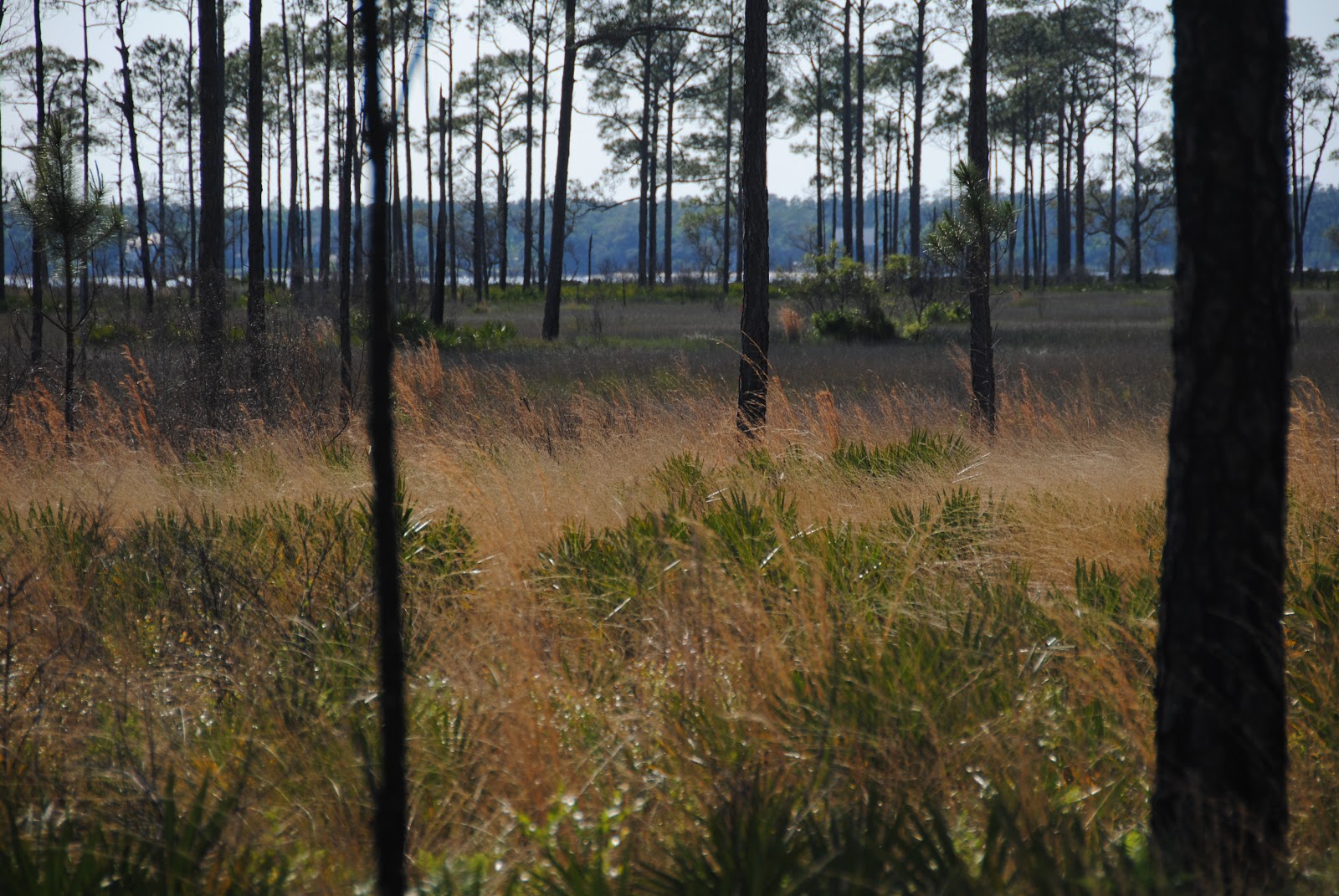
The pine flatwoods of Blackwater River State Forest where the wild boar roam.


These two photos illustrate the effects of "managed"
wildfires. Not the young, red-colored pines and the charred
black trunks of the adults.
I was at Blackwater River State Park more than any other state park this spring. It is an incredibly diverse region, from pitcher plant bogs to cypress swamps to pine flat-woods. Most of the photos taken on this post were taken by Andrew, a friend of mine. While I creep around looking for reptiles and amphibians, my friend seemed obliged to take on the role as the trip photographer. On my first trip to the park, it was only the first week of March, and the day was mostly overcast and quite cold. There were four to our party. We found that the trail, boardwalks and all, had been swallowed up by the swollen river. It was quickly decided (not by a majority vote) that we should simply wade through the cypress swamp. The water usually didn't pass my thighs; however, one crossing came a little higher. Here, one of my friends let out a shriek and thrashed out of the water. I chuckled and used my net to move a large, surprised wolf spider out of the frothing water. There happened to be a drop off into the river at that point as well. "Watch your step," I said. "There's a big drop into the river right here. I moved out my foot over the submerged edge. No sooner had I finished my warning, that one of my company dropped off the bank and up to his chest in cold water. Besides the spider, cricket frogs, darters (a small fish), and a few ranids (large semi-aquatic frogs) where all the wildlife we saw that trip. To cold.
The next venture into the park was little better. Cricket frogs were encountered once again, but we trekked higher into the pine flatwoods, away from the river. Sign of dear and wild boar where evident, as well as a possible set of coyote tracks. Some songbirds were spied. The primary highlight of this trip was the discovery of a pitcherplant bog. These are carnivorous plants that fill there attractive, cup-shaped flowers with a digestive fluid. Woe be tide the hapless insect that falls in and watches, with blurring compound eyes, the pitchers lid closing over its last glimpse of the sky.
The plant to the left is Sarracenia leucophylla, the whitetop pitcherplant. Unfortunately, the beautiful colours of this plant were faded on my specimens so the significance of it's name isn't clear here. Ideally, however, the plant would have a reticulate colouring of red on white. Just stunning. Many pitcher plants are endangered and caution should be taken when identifying the species of pitcherplant. In the case of S. leucophylla, the endangered S. rubra looks very similar when not in full colour. In my experience, S. leucophylla is a tall species, equally happy growing on the edge of the bog or pond, or up a creek bank. It grows tall and conspicuous.
The two photos on the right are of a different species, S. purpurea. I was delighted to discover that this is a rarer species in the region I was in. Apparently, it is usually found further inland. This species is a lover of swampy ground, appearing dry, brown, and withered if it is any distance from moisture. Perhaps this is because it grows so much closer to the ground and has less opportunity for expansion (though I don't know how these plants reproduce).
This little excursion has wet my appetite for botany. Especially carnivorous plants. In the final photo, I am creeping about the bog spying on cricket frogs.