Pages

Showing posts with label birding. Show all posts

Saturday, 7 January 2017

Life on Mount Washington

August 17, 2016

This little guy was begging us for food. Juvenile grey jays, like this one, may never develop the ability to find food for themselves if they get handouts from humans. When winter rolls around, he may starve.
Mount Washington is home to an alpine resort, ski village, mountain biking club, hiking trails, and many other tourist attractions. So, needless to say, the challenges faced by wildlife and vegetation are usually rooted in human causes.
Vegetation has a particularly challenging prospect. The face of the mountain may be criss-crossed by ski trails, chair lifts, and hiking paths, but crowds of people still feel the urge to tromp out of bounds. The authorities do their best to keep the folks on the trails but the imagination of many people dictates that they pursue the better view through the underbrush.
Colorful lichens grow on the rocks by the trail. They are often the first organisms to colonize mountainous habitats so, when an area is disturbed (such as a trail), they may cling on when other forms of vegetation have been vanquished.
Animals also have to cope with human influences and some are all to eager to take advantage of our sentiments. Possibly the most famous example of animal-human interactions is that involving food. On Mount Washington, the grey jay is the primary offender. This small bird is so accustomed to human handouts it will even land on outstretched limbs, provided there is a snack in the palm. Like deviating from the trail, a close encounter with a mountain bird is nearly impossible to resist. Of course, the birds don't really benefit from being fed. For starters, junk food isn't healthy for anyone. Second, when the juvenile birds become addicted to the human trash, they won't know what to do with themselves when winter rolls around. In other words, feeding the birds, eliminates their ability to fend for themselves. They never learn. As a result, populations of grey jays have actually declined because youngsters aren't surviving the winter.
A western meadow fritillary warms itself on the grey stones lining the paths on Mount Washington. The insects on the mountain generally avoid people, but we did encounter a nest of small wasps that swarmed anyone who stood too long on the boardwalk overlooking the Forbidden Plateau. Fortunately, they were too small to cause people any discomfort.
On the other hand, people learn to love the things they can touch. A bird landing on a child's hand is a very positive interaction with nature for a kid. It teaches him to love nature and that may be more important than that particular bird's ability to survive. Every kid that grows up loving wildlife is a victory for nature.
A grey jay junky casts a hopeful glance in my direction.

Monday, 26 December 2016

McCoy's Pascagoula River Tours

October 8, 2016

In early Autumn, the bald cypress (on the right) turn tints of orange in the swamps of the Pascagoula River.
Every year for the last three years, I have had the opportunity to visit the Pascagoula River Audubon Center (PRAC) in Mississippi with the Ecology class at Pensacola Christian College. It is an opportunity I cannot pass up.
The Center itself is a beautiful facility. The old building was very rustic, but definitely in need of renovations. So when PRAC moved to a new location, a brand new building was constructed with beautiful displays of Pascagoula fish, reptiles, and amphibians. The Center is a great, educational place to start any outdoor adventure but for a complete Pascagoula experience you must take one of the boat tours of the river. There are three kinds of people who need to take a tour of the river: bird watchers, nature and wildlife lovers, and everyone else. Because everyone should love nature and wildlife.
A great egret stands nobly on the shore of an oxbow lake. This bird had learned that passing boats washed minnows up onto the muddy shores--easy pickings for the egret--so it sometimes followed boats, eagerly anticipating its next meal.
For the 2016 tour, we piled into Captain Benny McCoy's swamp boat and puttered out into the marsh. As Captain McCoy explained, the brackish marsh is a very different place than the swamp. The marsh is dominated by tall leaved monocots like wild rice and needle rush; the swamp has trees (mostly bald cypress) and is far enough up the river to avoid saltwater infusion.
If you are as lucky as we were, you'll see herons, egrets, ospreys, king fishers, rails, and many more fabulous wetland birds. Captain McCoy knows exactly where to find alligator nests and occasionally, we see alligators (I've seen them twice in the three times I've gone).
A juvenile alligator watches us calmly from the waters near the launch point of Captain McCoy's boat.
Captain McCoy explained that this little 'gator may be a rescue-and-release. Because there are so many alligators in Florida, only small ones are released if they must be relocated. Large adults must be killed or placed in special housing facilities like Alligator Alley.
When you fulfill your destiny aboard Captain McCoy's rig, let me know about your highlights in the comments below.

Saturday, 24 December 2016

Bear Lake Trail

October 1, 2016

From left to right: Eric Brewster, Cory Von Eiff, and Josiah Shade hike the Bear Lake Trail loop through a stand of longleaf pines early on a cool October morning. 
I've posted a lot this month about Bear Lake. It's time I expounded on that.
Blackwater River State Forest extends from the coast of Florida's panhandle (in Santa Rosa County) up to the Alabama border. It features many beautiful hikes, paddles, and camping spots along the meandering white sands of the Blackwater River. If you've never been to the forest before, the very recreational Blackwater River State Park offers canoe rentals, tubing, camping, hiking, swimming, and more. But this post isn't about the state park. If you are interested click on the label at the right for Blackwater River State Park (they are in alphabetical order).
At the northern tip of the forest, there is a clustering of small, man-made reservoirs. One of these is Bear Lake. The Bear Lake Trail and the Sweetwater Trail meet here and, taking the Sweetwater, you can hike up to the Krul Recreation Area, which also offers camping. There are a number of trails and camping spots around the lake, including Bear Lake Recreation Area, on the west side of the lake. The recreation area offers many amenities but it will cost you money to camp, boat, or otherwise enjoy the facilities. I'm too cheep, generally speaking, and so I usually pass the road into the recreation area and take the next left off of Highway 4. It's the first left off of that paved road that will take you down to a boat ramp. There is also room for tenting down there.
Swamp sunflowers (a kind of daisy) sprout up from the clustered bases of a stand of bald cypress. There are many wonderful swamps tucked away in the corners of Bear Lake, but this one was at the eastern side.
The 4-mile Bear Lake Trail, starting left at the south boat ramp, will take you through pine forest, and a bit of hammock and swamp, to the dam at the Bear Lake Recreation Area. From there you can take the Sweetwater Creek Trail up to Krul, or continue along the east side of the lake. You will pass meadows of pitcher plants and quaint beaver ponds before taking the pine flatwoods back to the south boat ramp. There is another recreation area on the south side but it is gated and generally used by large groups, such as clubs or churches.
Pitcher plants are commonly found at Bear Lake, but are best viewed from the Bear Lake Trail on the eastern side of the lake. There are benches and platforms overlooking the pitcher plants-- perfect for photography opportunities without disturbing the meadows.
Most importantly, you will see wildlife. Fishing, hunting, and birdwatching, are common pastimes around Bear Lake. Among mammals, you will find deer, beavers, grey squirrels, wild hogs, and, if you're especially blessed, bears. Birding is incredible at Bear Lake. In fact, there are nearby trails that are part of the Great Florida Birding Trail. I can't really highlight specific birds here other than bald eagles and swallowtail kites. However, I've never seen the kites myself and the eagles are much easier to see a little ways north at Hurricane Lake. My favorites are, of course, the reptiles and amphibians. There is a good diversity of frogs at Bear Lake and I've personally found green treefrogs, cricket frogs, leopard frogs, southern toads, and bullfrogs. I've seen watersnakes, cottonmouths, and black racers, but I've been told their are rattlesnakes and alligators in the park as well, though I've never seen them.
As always, respect the wildlife while you are out hiking and whatever you pack in, be sure to pack it out.

The Bear Lake Trail, through the pine flatwoods.

Tuesday, 20 December 2016

British Columbia Beaver Ponds

December 19, 2014

Beavers have flooded the trail, diverting the waters of Stories Creek away from their dam. The western hemlocks in the background seem to be fairly flood-resistant.
I was born and raised on Vancouver Island, off the grey west coast of British Columbia. We seldom got snow and it seldom didn't rain. We called it a temperate rainforest, but it was far from tropical--mild winters and mild summers.
As a student in Florida, I missed the grey skies, wet forests, and short days. It was really made mandatory by my loving parents, but Christmas was always spent back home on the island. My siblings and I would fly up from Florida every December, just to be with family.
It proved to be precarious hiking over this trail-turned-creek. The deer ferns are evergreens that enjoy moist areas. Perhaps this is too moist.
I of course took this opportunity to get outside. My parents lived in a coastal fishing town called Campbell River and it rarely got snow. The forests surrounding the town were dark and wet, full of soggy, decaying wood and draped in mosses. Three colours predominated: brown, green, and grey. The grey sky sandwiched the green of the mosses and evergreens against the reddish-brown soil and tree trunks. I was looking for animal life, of course, but the forest was surprisingly quiet. It was late afternoon, but the sun was already setting somewhere behind the high, grey clouds. It made me feel alone, but not lonely. Rather, it was very peaceful. A quiet tit sound notified me of a thrush's presence. In the summer, it might be true that "birds of a feather flock together" but, in the winter, there is no prejudice. They seem to work together to flush up insects and watch for predators. This thrush was sending an early warning to someone about my presence. After several minutes of listening I could discern some other birds in the trees. Chestnut-backed chickadees, golden-crowned kinglets, varied thrushes, and even a few brown creepers. I walked another hundred meters up the trail and everything became silent again.
One of the Stories Creek beaver ponds as seen from the trail. It is amazing how much nostalgia can be associated with a place like this. Beavers and birds might be the only obvious critters here in December, but as early as January the long toed salamanders will be moving in to breed, superseded by a whole host of others, including northwestern salamanders, rough-skinned newts, red-legged frogs, and Pacific treefrogs.
The trail followed part of Woods Creek before taking an old, overgrown logging road across to Stories Creek. Both creeks were full and rushing from the latest rainfall. Some places on the island can get over three meters (ten feet) of rain a year. Soon, I was skirting the edges of the muddy trail to avoid getting anything past my ankles wet and leaning precariously over the trail to keep my scarf from catching on the wet shrubbery. The reason for the flooded trail had more to do with engineering than the water table. A beaver dam had grown out from one of the ponds and clogged the natural flow of water back to the creek. The trail made a fine spillway. I thanked God for my long legs and jumped over the obstacle.
Another one of the Stories Creek beaver ponds. Dusk had already arrived in the forest, it seemed, by 3pm.
There were several ponds up Stories Creek, all of them beaver-constructed. Originally, small dams and spillways were constructed along the stream to help salmon move and reproduce. It was originally part of the local gulf club's mitigation project but, now, the pressure-treated dams are in a sad state of decay. The club made up for the neglect by periodically smashing out sections of beaver dam. I hardly think that behavior is justified.
Sword ferns blanket the forest floor, under a stand of red alder. The ferns are evergreens and continue to grow tall until the first snowfall, which may never arrive.
As the forest became too dark to see the trail, I headed back toward home. My footsteps were the only sound and it made me uncomfortable. I found myself hurrying along, as if the growing darkness would only tolerate my disturbance for moments longer. Another thought comforts me: Rooibos tea. When I'm huddled by the wood stove, watching the lights on the Christmas tree, I'll have a cup of hot, rooibos tea.

Saturday, 8 October 2016

Pascagoula River Birding

Porzana carolina. Pascagoula River, Jackson County, Florida. October 2014. Nikon D3000.

In part of my flashback series for this month, I searched through all my photos for the month of October and selected one from each month to post to my blogs. This one was taken October 11, 2014 during a Saturday outing with my Ecology class. I managed to do it again last year as a faculty member and then again today (October 8, 2016). Every time I've gone, we've seen at least one of these little delights. The sora rail is a secretive little marsh-dweller, and I am inordinately fond of all wetlanders.

Tuesday, 19 July 2016

Heron Tracks

I just spent a very busy four days walking up and down the beaches of Florida's Panhandle. I was counting heron tracks for a wildlife index. I had three sites, each about an hour and a half walk along white-sand shoreline. I learned a lot about heron habits and tendencies but also made some sketches of the tracks out there in the state and national parks. Besides heron tracks, I also encountered some other big bird tracks. The one on the right isn't from a heron. It's an osprey track. The real giveaway was the slightly sideways projecting toe. It was nearly as large as the track of the heron, though.

Tuesday, 5 August 2014

Birding for the Faint of Heart

Things have been busy rapping up the last weeks of my internship, but I wanted to update everyone on my life list status. Since my last post on birdwatching, I've got ten new species. Unfortunately, many of my pictures from my field notes are not ready to be posted but in the near future, I hope to offer a more complete picture of my time spent in Indiana. Until then, here are the new birds for the list:
Unfortunately, we've all seen this picture before. I should have new
pictures for posts coming in the near future.

132: Wild Turkey - I rather enjoyed encountering these strange birds. The first time I saw them was about eight years ago or more near Yellowstone National Park. A few of them were in the distance as we drove past an opening in a forest by the highway. It was a fleeting glimpse. This summer, I saw several more on the side of the railway tracks from South Bend to Chicago. Most recently, one was seen at Indiana Dunes State Park on the 27th of July. Walking down a closed boardwalk (due to flooding) I heard something rustling in the brush along the edge of the swamp. I crouched for a closer look and determined that some creature with a bushy face was crawling out from under a pine tree. Its rear end emerged and a long curved tail spun around. Of course, I'd been looking at it backwards--the tail was its neck and head. They are strange but beautiful birds.

133: Red-headed Woodpecker - On a suburban road near the Tippecanoe River. Startlingly brilliant.

134: Tree Swallow - Also at the Tippecanoe, swooping low over the water, often juveniles, either practicing flight, playing games, or catching insects. Undoubtedly the adults were after mayflies or the like.

135: Black-billed Cuckoo - Skulking around the lakes at Notre Dame. Cuckoos have always struck me as very exotic, as I mentioned in a post when I saw the yellow-billed species.

136: Tufted Titmouse - Also at the Notre Dame lakes, these birds were much larger than I expected.

137: Rose-breasted grosbeak - My final trip to Potato Creek State Park turned up three new species for my list, including this one, seen at a bird feeder outside the nature center.

138: Eastern Phoebe - Seen hunting invertebrates above the trail in Potato Creek's forest canopy.

139: White-eyed Vireo - A family of these birds was seen off of one of the trails at Potato Creek State Park.

140: American Black Duck - Undoubtedly, many of the "mallards" at Notre Dame are actually American black ducks, I only just noticed them now.

141: Snowy Egret - I thought it was a great egret at first but, on closer inspection, it was certainly too small for that.

Wednesday, 18 June 2014

PHOTO OF THE WEEK: Brown-headed Cowbird

Do you notice anything wrong with this picture? I was walking to dinner yesterday (June 17th, 2014) on the campus of the University of Notre Dame in South Bend, Indiana when I happened upon this fascinating scene. A chipping sparrow (Spizella passerina) bounced up to a chirping, young icterid (blackbird family). As the young bird increased its excited begging, the sparrow dropped a morsel down its throat. Of course, by then I knew exactly what was going on. The brown-headed cowbird (Molothrus ater) is a parasite!
A female brown-headed cowbird can lay over 30 eggs a spring but most of these will never develop. While many eggs are rejected by the host birds, other young cowbirds are left to die after they hatch as the victim parents discover the truth about their youngster. Cowbirds don't always pick the right nest, either. If the host bird is a fruit eater, the baby cowbird can't get the protein it needs to develop and survive. Yes, life is hard as a cowbird. To help with this, cowbirds make life very difficult for bird families that won't "adopt" their babies. If an egg or young cowbird is rejected from a nest, the cowbird parent will terrorize the nest, often killing the natural young inside or destroying the nest altogether. In the case I photographed above, it appears as if the only surviving youngster in the family was the cowbird.
The bird gets its name from its previous way of life in the midwest and great plains; following the great herds of bison (Bison bison). Although the bison herds are largely dissipated, the cowbird has found living in suburban areas suitable. You've got to respect a bird that has adapted to a lifestyle among the causers of the disappearance of its previous way of life.
I had to wait about 15 minutes under the tree before the sparrow returned once again to feed the cowbird chick and I was able to get this photo. Although many people work against cowbirds to try to eradicate them, I appreciate the cowbird's way of life as a natural part of a cursed world. It's just like predation: it's not pretty, but it is a natural part of life (and death). And besides, the thinning of the species actually increases the amount of parasitism that takes place because cowbirds do not desert as many parasitized nests when populations are low (see reference below).

Reference:

Hall, Ackert. 2008. “Cowbird Removals Unexpectedly Increase Productivity.” Ecological Applications. 18(2):537–48. Retrieved June 18, 2014 from http://www.k-state.edu/bsanderc/2008ecolappl.pdf


Friday, 6 June 2014

Birding Update: Now 131 Species!

Yellow-throated vireos are gorgeous, eh?
Amazing that this, of all years, would be the one I chose to do a little Big Year. Without birding as my primary purpose I've dodged back and forth from the two farthest corners of the continent. From the Pacific northwest to the southeast and back. Well, now my pursuit of biology as a career has brought me to the midwest, under the Great Lake Michigan. My list is rising rapidly and I have a good feeling about making it to 150. Maybe I should raise the bar to 200, eh?

Bird 123: Sandhill Crane on May 28th
Although this bird was only seen for a fleeting moment as it flew over a farmers field on a tile drain water sampling trip for my ecology internship, it made a great impression. It seemed to be suffering under the constant and determined harassment of a blackbird. Why a blackbird would have any reason to give a gentle crane a hard time I haven't any idea. I only very rarely see cranes in the wild, and they always seem to be high in the sky flying in formation. I love they way they fly with their necks outstretched. Very unlike herons and egrets which fly with and S-curve in their necks.

Bird 124: Black-crowned Night-heron on May 29th
I think if I was a female yellow-throated
vireo, I'd be all over this guy.
He's a beauty!
I'll be honest; I didn't expect to see this bird so far north. Last time I saw night-herons it was in a hot muggy Texas swamp. He did seem a little out of place; at a suburban lake putting up with a lot of human foot traffic and noise from some kind of giant generator on the lakeshore of the University of Notre Dame. When I entered this bird into my list on eBird, they notified me it was a rare bird for that area, but I double-checked my pictures and there can be no doubt that it is a black-crowned night-heron.

Bird 125: Chipping Sparrow on May 29th
This is one of those birds you hear a lot about from different people and I kind of thought I would see one long before now. There were a couple under a young hardwood of some kind on the lawn of one of the academic building's on Notre Dame's campus near the lakes. It's about time I saw a sparrow besides the introduced house sparrows which are all over campus.

Bird 126: Chimney Swift on May 30th
Another American classic. I have seen several of these darting around the campus skies.

Bird 127: White-breasted Nuthatch on May 30th
I kind of thought that this bird was already on my list somewhere, but there is no record of it in eBird so I must just be remembering last year. Nuthatches are some of my favourite birds; they bounce around tree trunks and limbs with no regard for gravity. I don't think it matters to them which side is up.

Bird 128: Yellow-throated Vireo on May 30th
Another one nailed at the lakes on campus at Notre Dame. First time EVER that I've been able to identify a vireo positively to the species. I'm getting better at this.

Bird 129: Orchard Oriole on May 30th
Actually, eBird doesn't know it, but I saw this bird about four minutes before the vireo, so they should really swap numbers. Anyways, it was a pretty rough looking young male of its species. Kind of frazzled and obsessed with preening.  Just like a teenager.

Wood ducks are always a pleasant find and there must be
3 or 4 pairs of them living on the lakes at Notre Dame.
Bird 130: American Woodcock on June 1st
Flushed out of the bush Sunday evening when I went looking for deer off trail in Potato Creek State Park. One deer. The woodcock might have been a bonus but I am fascinated by these woodland sandpipers and, if I'd known it was there in the first place, I would have sneaked more lightly to perhaps see some behaviour of this shy bird.

Bird 131: Yellow Warbler on June 1st
I didn't even realize that this was a new bird for my list. I've seen yellow warblers before and I figured they were already on my list. However, this was the first time this year I'd seen one, eBird informed me. I'm happy about that because it puts me over 130. Now I have to get to 150. Things have been to good to let down my search. I have a haunch that I will make it to 200 if I'm aggressive.

Thursday, 22 May 2014

New Birds for the Years Life List


Rather than repeating that massive list every time I make a post, Let's just update the one we've got. Over the last week I've seen some pretty amazing new species. Old favourites and brand a couple brand new birds I've never positively identified before. Birds 116 and 117 were seen on a river hike up Woodhus Creek on the 17th of this month (May). Creek hiking is an increasingly popular pastime. We see a lot of wildlife simply by throwing on a pair of shorts and our Keen sandals and using the creek itself as a path. The solitary sandpiper was seen a few times as it worked its way up the creek bed away from us. This was the case for most of the birds we saw today including an American dipper. I love dippers. They dance around the rushing water, bobbing their little bottoms periodically and looking like little curtsying bird princesses. I always felt a better name would have been American bobber. However, they do dip. To catch aquatic larvae, the dippers dive right into the rushing river and pluck the hapless invertebrates off the stones they cling to in the current. Another bird seen on that trip was a pair of Harlequin ducks. I've already seen some of those this year; on the ocean surf near Oyster River Estuary. However, that was the winter. To breed, these ducks move into whitewater streams.


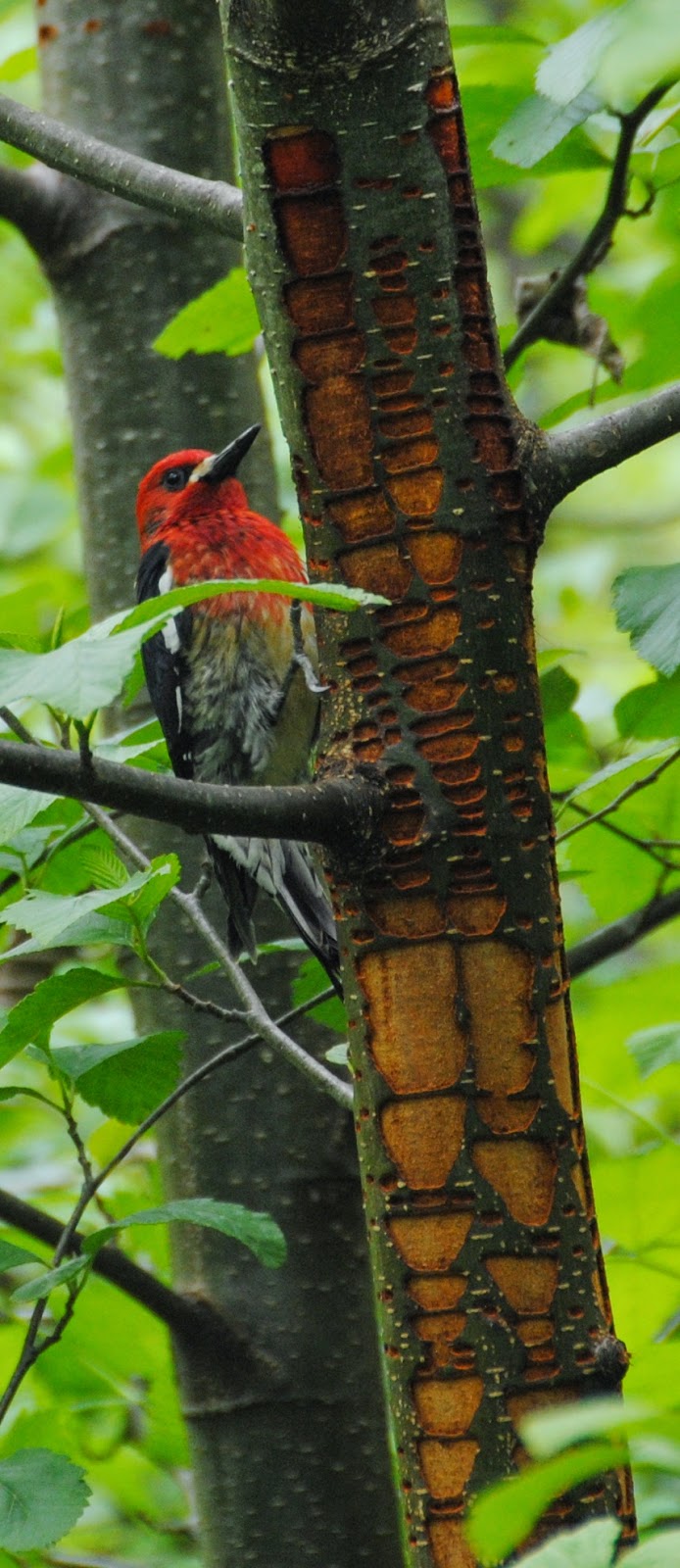
On the 19th, a hike up ripple rock trail scored a few more new species for my list. A red-breasted sapsucker was one of the first birds I saw on the trail, hammering out its characteristic oval shaped sap holes in the bark of young red alders. The purple finch on the way out was a new one for the list as well. Interestingly, it seemed to be suffering from some sort of disease on its face, rendering one eye uselessly sealed shut. Lastly, when we were almost back home, a noise stopped us in our tracks. "Barred owl," said my dad, who has far more experience as an outdoorsman than I do. "No," I said, "During the day? It must be those ravens we heard a moment ago." My Dad replied confidently, "No, it was a barred owl." To settle the disagreement, he performed a good imitation of the barred owl's call. To my surprise, the barred owl hooted back, "Who cooks for you!" No doubt now. Dad was right; it was a barred owl, and the 120th bird on my list.

Closer to home, I nailed an orange-crowned warbler and an olive sided flycatcher with its characteristic call of "Quick! Three beers." I can't complain about 122 birds. A goal of 200 before the years end may be a little optimistic, so lets call it a hope. The goal will be 150. In summary, here are the new birds.

May 17th, 2014
116. Solitary Sandpiper
117. American Dipper

May 19th, 2014
118. Barred Owl
119. Red-breasted Sapsucker
120. Purple Finch

May 20th, 2014
121. Orange-crowned Warbler
122. Olive-sided Flycatcher

Thursday, 15 May 2014

Birding Progress Update.

Barred owl. I haven't got one of these for my list this year yet but, in the
past, they have been easy to find. I should have one shortly.
I recently published the following list under the photo of the week at my homepage. However, I had commented that I was going to try to make it to 110 species before leaving Florida. The good news is, I did. The better news is, I actually made it to 111 with the fabulous additions of great horned owl, summer tanager, and chuck-wills-widow. The great horned owl was heard during our canoe trip down the Blackwater River, but I couldn't include it in the list until I was certain that was what I heard. After learning that the only two other owls known in the park were the screech and barred, I knew it could be neither of these. It must have been a great horned by process of elimination. Two of the other people with me on the trip, including an experience outdoorsman, confirmed my conclusion.
Now today is the 15th and I've been spotting a few more species. Here is the updated list.

January 1st
1. Chestnut-backed chickadee
2. Varied thrush
3. Dark-eyed junco
4. Northwestern crow
5. Glaucous-winged gull
6. Trumpeter swan
7. Bald eagle
8. Northern flicker
9. Spotted towhee
10. Song sparrow

January 2nd
11. Red-breasted nuthatch
12. Fox sparrow

January 3rd
13. Downy woodpecker
14. Pileated woodpecker
15. Common raven
16. Pacific wren
17. Golden-crowned kinglet
18. Hermit thrush
19. American robin

January 4th
20. Canada goose
21. American wigeon
22. Mallard
23. Harlequin duck
24. Surf scoter
25. Bufflehead
26. Common goldeneye
27. Common merganser
28. Common loon
29. Great blue heron
30. Hairy woodpecker
31. Eurasian collared-dove

January 5th
32. European starling
33. House sparrow
34. Northern pintail
35. Green-winged teal
36. Black-bellied plover
37. Killdeer
38. Sanderling

January 7th
39. Steller's jay

January 12th
40. Black turnstone
41. Eared grebe
42. Double-crested cormorant
43. Pelagic cormorant
44. Dunlin
45. Black oystercatcher

January 16th
46. Bewick's wren
47. White-winged scoter

January 17th
48. Red-tailed hawk
49. Rock pigeon

January 18th
50. Ring-billed gull

January 19th
51. Northern mockingbird

January 20th
52. Mourning dove
53. Red-bellied woodpecker
54. Blue jay
55. Pine warbler
56. Yellow-rumped warbler
57. Yellow-throated warbler

January 25th
58. Brown-headed nuthatch
59. Eastern bluebird
60. Palm warbler
61. Eastern towhee
62. Northern cardinal
63. Red-winged blackbird

January 27th
64. Pine siskin
65. American goldfinch

February 1st
66. Turkey vulture
67. Belted kingfisher

February 5th
68. House finch

February 8th
69. Redhead
70. Red-breasted merganser
71. American white pelican
72. Brown pelican
73. Great egret
74. Osprey
75. Willet
76. Ruddy turnstone
77. Laughing gull
78. Herring gull
79. Forster's tern
80. Loggerhead shrike
81. Savannah sparrow

February 15th
82. Red-shouldered hawk

February 26th
83. Cedar waxwing

March 11th
84. American crow

March 12th
85. Bonaparte's gull

March 15th
86. Fish crow
87. Ruby-crowned kinglet

April 5th
88. Least bittern
89. American coot
90. White-winged dove
91. Yellow-billed cuckoo
92. Ruby-throated hummingbird
93. Eastern kingbird
94. Gray catbird
95. Prairie warbler
96. Bachman's sparrow

April 10th
97. Clapper rail

April 12th
98. Common grackle
99. Brown-headed cowbird
100. Green heron

April 25th
101. Common nighthawk

May 3rd
102. Brown thrasher
103. Bay-breasted warbler
104. Scarlet tanager

May 8th
105. Black vulture
106. Spotted sandpiper
107. Great horned owl
108. Cliff swallow
109. Carolina Chickadee

May 9th
110. Summer Tanager

May 10th
111. Chuck-wills-widow

May 14th
112. Wood duck
113. Band-tailed pigeon
114. Rufous hummingbird

May 15th
115. Black-throated gray warbler

Friday, 9 May 2014

PHOTO OF THE WEEK: Laughing Gulls and Ring-billed Gull

This photo won second place in one of my school's photography contest categories. I titled it "Social Outcast."

I'm back from college finally. It has been a very busy few months: I ran 19 credits and somehow still managed to get out to the bush every weekend but two (for Finals and Midterms). That being said, it has been a very significant year. It was one of the coldest springs ever documented in Florida as we braved an ice storm and, later in the semester, flooding was severe enough to kill at least two people in a Pensacola hurricane. As for birding, here is the updated (and correct list) for this whole year. After reading a post on Greg Miller's blog (http://www.gregmillerbirding.com/), I set up an account with eBird, an online database where I could submit my observations from each weekend. For only going out for about two hours each week, I think I did pretty good.

January 1st
1. Chestnut-backed chickadee
2. Varied thrush
3. Dark-eyed junco
4. Northwestern crow
5. Glaucous-winged gull
6. Trumpeter swan
7. Bald eagle
8. Northern flicker
9. Spotted towhee
10. Song sparrow

January 2nd
11. Red-breasted nuthatch
12. Fox sparrow

January 3rd
13. Downy woodpecker
14. Pileated woodpecker
15. Common raven
16. Pacific wren
17. Golden-crowned kinglet
18. Hermit thrush
19. American robin

January 4th
20. Canada goose
21. American wigeon
22. Mallard
23. Harlequin duck
24. Surf scoter
25. Bufflehead
26. Common goldeneye
27. Common merganser
28. Common loon
29. Great blue heron
30. Hairy woodpecker
31. Eurasian collared-dove

January 5th
32. European starling
33. House sparrow
34. Northern pintail
35. Green-winged teal
36. Black-bellied plover
37. Killdeer
38. Sanderling

January 7th
39. Steller's jay

January 12th
40. Black turnstone
41. Eared grebe
42. Double-crested cormorant
43. Pelagic cormorant
44. Dunlin
45. Black oystercatcher

January 16th
46. Bewick's wren
47. White-winged scoter

January 17th
48. Red-tailed hawk
49. Rock pigeon

January 18th
50. Ring-billed gull

January 19th
51. Northern mockingbird

January 20th
52. Mourning dove
53. Red-bellied woodpecker
54. Blue jay
55. Pine warbler
56. Yellow-rumped warbler
57. Yellow-throated warbler

January 25th
58. Brown-headed nuthatch
59. Eastern bluebird
60. Palm warbler
61. Eastern towhee
62. Northern cardinal
63. Red-winged blackbird

January 27th
64. Pine siskin
65. American goldfinch

February 1st
66. Turkey vulture
67. Belted kingfisher

February 5th
68. House finch

February 8th
69. Redhead
70. Red-breasted merganser
71. American white pelican
72. Brown pelican
73. Great egret
74. Osprey
75. Willet
76. Ruddy turnstone
77. Laughing gull
78. Herring gull
79. Forster's tern
80. Loggerhead shrike
81. Savannah sparrow

February 15th
82. Red-shouldered hawk

February 26th
83. Cedar waxwing

March 11th
84. American crow

March 12th
85. Bonaparte's gull

March 15th
86. Fish crow
87. Ruby-crowned kinglet

April 5th
88. Least bittern
89. American coot
90. White-winged dove
91. Yellow-billed cuckoo
92. Ruby-throated hummingbird
93. Eastern kingbird
94. Gray catbird
95. Prairie warbler
96. Bachman's sparrow

April 10th
97. Clapper rail

April 12th
98. Common grackle
99. Brown-headed cowbird
100. Green heron

April 25th
101. Common nighthawk

May 3rd
102. Brown thrasher
103. Bay-breasted warbler
104. Scarlet tanager

May 8th
105. Black vulture
106. Spotted sandpiper
107. Cliff swallow
108. Carolina Chickadee

I will be leaving for home again on Sunday. The question is, can I nail two more birds in Florida for a total of 110 in just one day? Not likely, but I will try. Thanks for reading!

Sunday, 12 January 2014

PHOTO OF THE WEEK: Burrowing Owl

This little guy was hanging out at the New Zoo in Green Bay, Wisconsin back on August 18 of 2010 - it was my birthday. He looks pretty determined and, no wonder, he was missing his left leg.

I'm sorry to say, but this week was a bit of a letdown as far as birding was concerned. I added two more birds to my list; black turnstone and Steller's Jay. The jays were around the local forest and neighbourhood and I never did get a good look at them. I know them by their call. The black turnstones turned up on a failed attempt to add some gulls to my list. There was a flock of the birds on the beach, poking among the rocks.
Now, as I mentioned, my real reason for going down to the beach for birds was to see gulls. I certainly saw a lot of them, but anything that wasn't a glaucous-winged gull was pretty much impossible for me to identify. I guessed at herring, Thayer's, mew, ring-billed, but I couldn't make a positive identification. Just when I thought I was getting close, all but the glaucous-winged disappeared. So, a potential of two or three more birds (which would have topped me at over 40 species) was lost in the hands of inexperience. I think I need a professional! I told my dad I was going to call up Mike Yip and ask if he would be my gull identification coach. Just joking, though, so Mr. Yip can rest at ease. Instead, I think I'll wait until the rain lets up and then try again with my camera. With pictures, I'll have all the time in the world to make an identification (let's hope that time helps).
So my list has expanded to just 39, one short of forty, for this week. And things don't look too bright for the future. I'm off to college in Florida again for the next few months and, while I may be able to get off on weekends to do some birding now and again, posts on this site will be rare. Don't expect weekly photos; they may not happen at all. It's going to be a brutally busy semester.

Sunday, 5 January 2014

PHOTO OF THE WEEK: Beaver Pond

One of the pools, created by beavers, up Woods Creek near Campbell River, Vancouver Island on June 20th of 2010.

Update on my First (Little) Big Year:

The first week of my little Big Year is coming to a close. Over the four days, I was able to identify 37 species of birds, which was very disappointing considering only three more species would have tipped me into 40. Oh well. I guess there's improvement pending for the future.
Taking the number for what its worth, however, 37 is a great count for just four days of my first big year, and I'm confident I can get at least two more for the list tomorrow, if the weather is still clear. And that seems to be the ticket. We've had a few beautiful (freezing) sunny days and the birds have been out in droves. It seems that things are really working out for this big year. The weather brings out other wildlife too, and walking along the Oyster River estuary trail, we saw some gorgeous sea lions cruising down the coastline. We also had an unexpected encounter with a group of friends and relatives so, even if I hadn't seen any birds, it would have been worth it.
So here is the list up to date, with habitats. I put the common name first, with the habitat occurrence in parentheses. All species listed have been seen at some point this week, but many of the occurrences are listed from voice identification alone. All were seen between Campbell River and the Comox Valley.
1. Varied thrush (suburban backyard)
2. Dark-eyed junco (suburban backyard, clearcut bush)
3. Chestnut-backed chickadee (suburban backyard, forest trees)
4. Northwestern crow (urban roadside, suburban coastline, forest treetops, ocean mudflats)
5. Glaucous-winged gull (suburban coastline, river estuary, ocean shoreline, urban field, ocean mudflats)
6. Northern flicker (suburban roadside, forest trees)
7. Spotted towhee (suburban backyard, forest bush)
8. Song sparrow (suburban backyard, clearcut bush, forest bush, beach driftwood, suburban roadside, urban roadside)
9. Trumpeter swan (suburban overhead)
10. Bald eagle (suburban backyard, forest treetops, ocean shoreline, ocean mudflats)
11. Fox sparrow (suburban backyard)
12. Pileated woodpecker (forest trees)
13. Common raven (forest treetops)
14. Pacific wren (forest bush, clearcut bush)
15. Golden-crowned kinglet (forest treetops, forest trees, forest bush)
16. Hermit thrush (clearcut bush)
17. American robin (clearcut bush)
18. Varied thrush (forest trees, clearcut bush)
19.  Mallard (river estuary, ocean mudflats)
20. Surf scoter (river estuary, ocean shoreline)
21. Harlequin duck (ocean shoreline)
22. Common goldeneye (river estuary)
23. Bufflehead (river estuary, ocean shoreline)
24. Common merganser (river estuary, ocean shoreline)
25. Canada goose (country field, open ocean)
26. Common loon (ocean shoreline)
27. Great blue heron (ocean shoreline)
28. Hairy woodpecker (forest trees)
29. Eurasian collared-dove (suburban backyard)
30. European starling (urban roadside)
31. House sparrow (suburban backyard)
32. Northern pintail (ocean mudflats)
33. American wigeon (river estuary, ocean mudflats)
34. Green-winged teal (ocean mudflats)
35. Killdeer (ocean mudflats)
36. Black-bellied plover (ocean mudflats)
37. Western sandpiper (ocean mudflats)
So there you have it. All 37 species and the habitats I observed them in. There were some ducks, sandpipers, and woodpeckers I saw as well but, because my identification could not be 100% certain, I had to omit these names. It is very tempting to include a name when you are 99% sure what it is, but such is life. So downy woodpecker and ancient murrelet were not included, among others.
Of course, I would love to describe exactly how many of each I saw, what they were doing, how they interacted with other animals, the kinds of plants that were around, and more, but this is just a weekly post. Maybe check the PROFILES page (click the FIELD NOTES link above) in the far future for a post on a specific bird's biology. That natural world is so amazing! Have a great week and don't forget to get outside.