Pages

Friday, 23 December 2016

Bugs to Find on a Cold Florida Morning

October 1, 2016

The zipper spider, Argiope aurantia, is a common inhabitant of suburban gardens.
You don't need to leave the trail to find cool bugs in Florida. Even when it's cold, arachnids and insects are never in short supply. Some, I confess, are not particularly pleasant. The lumps on the back of my neck are a testimony to mosquitoes.
However, the vast majority of Florida bugs are stunningly beautiful. In October, there are still a lot of crigs (crickets, grasshoppers, and katydids) to be found, and the large Schistocerca (which the locals call "locusts") are especially obvious, buzzing from tree to tree when they are approached.
The spider webs are just gorgeous in the early, golden light of morning.
Certainly among the most interesting bugs are the spiders. On this morning, the web-spinners are easy to spot. With silk speckled by morning dew, and their creators suspended optimistically in their centers, everyone notices (except for, apparently, that passing moth that is also now suspended in the web). Spiders are remarkably colourful. The bright yellows of banana spiders and zipper spiders can give the impression that this is the tropics. And I suppose Florida is subtropical, but it hardly feels that way when the temperature is down in the 40s (Fahrenheit).
Josiah Shade admires the colours of Nephila, the banana spider.
Traditionally, wooly-bear caterpillars have been seen as indicators of the coming winter months. Unfortunately, there isn't much scientific basis for this old wive's tale but the caterpillars do turn up in the fall in significant numbers as they search for a place to hunker down and spend the cooler months. My friend spotted this fantastic variety of the wooly bear caterpillar of the Virginia tiger moth. There are a few different colour phases of this caterpillar but the snow-white variety that we found is particularly stunning.
Spilosoma, the wooly bear caterpillar. This particular variety of the Virginia tiger moth produces snow-white caterpillars.
Bugging (the act of seeking out bugs) is an extremely rewarding exercise. As a classic naturalist, it never lets me down. When I can't find the reptiles I'm herping for, I can always find bugs. When the birding is bad, there's a bug. Sometimes, I just ditch the other kinds of wildlife that could be found and focus on bugs alone. No other group has so much diversity and colour.

The shadow of a large female Nephila is cast on the cheek of Josiah Shade.

Florida Forest Fog

October 1, 2016

Like an angelic spotlight, the sunlight seems to me to be warmth incarnate on this cold, misty morning.
We began our hike on the west side of Bear Lake. Steam fog (read about it here), it would seem, is not limited to bodies of water. Throughout the cool forest, a mist was drifting amid the trunks of longleaf pine. Although it was very cold (for Florida), there was nothing creepy or mysterious about the forest. Golden rays of early morning light were sending beams through the mist and our happy quartet was taking every opportunity to photograph each drop of dew.
Coming up, I'll post on some of the wildlife we found while hiking. For now, enjoy these artistic shots of the mist and morning light of the forest. Thanks for reading!

The haze creates quite a contrast between foreground trees and the faded flora in the background.

Things are getting brighter in the forest and the mist is beginning to clear. The light is so gold and warm; I can tell that it's going to be a perfect day for a hike.

Black and whites were a temptation that I couldn't resist.

This photograph was taken at the same angle as the introductory one (at the top of this post) but I took this one in monochrome.

It's hard to get past the contrast. It is so beautiful! Wish you could have seen it.

Wednesday, 21 December 2016

Florida Steam Fog

October 1, 2016

It was colder than it looks. Steam fog rises in wisps from the surface of the warm water. It is a perfect morning for a hike.
The last night of September was cold, at least by Florida standards, and it dropped into the 50s (Fahrenheit). In spite of the chill, I had planned to wake up at 5am and go hiking with some friends up at Bear Lake (northwestern Florida, close to the Alabama border). The last time I was out with these guys was last spring, several months ago, but, when you live a busy academic life like ours, friendships run independent of time.
The following two photographs are experiments in monochrome. The unique qualities of the mist and light gave excellent opportunity to play with filters, settings, and program edits.
This might be were photography becomes more of an art than a form documentation. However, the crystal-like sparkles on the surface of the water are real and I might produce a coloured version of this photograph in the future.
We left later than we had intended and arrived at the lake close to 6:30am, after a 30 minute drive northward. The Gulf must have a significant warming affect on coastal Florida because, once we arrived at the lake, temperatures had dropped bellow 50 degrees Fahrenheit. Those who had sweaters wore them.
The lake was covered in a carpet of mist, like a sheet of silk waving lightly over a glass mirror. The beautiful phenomenon offered an excellent photography opportunity. Steam fog, as it is sometimes called, occurs when the water is warmer than the air. As the warm, moist air from the lake rises and cools it passes its dew point and the water condenses as fog. Together with the orange tints of the cypress leaves, it looked like, here in Florida, Autumn had arrived.
This photo was taken at the same angle as the one above in monochrome. Morning light is so perfect for photography.

Tuesday, 20 December 2016

British Columbia Beaver Ponds

December 19, 2014

Beavers have flooded the trail, diverting the waters of Stories Creek away from their dam. The western hemlocks in the background seem to be fairly flood-resistant.
I was born and raised on Vancouver Island, off the grey west coast of British Columbia. We seldom got snow and it seldom didn't rain. We called it a temperate rainforest, but it was far from tropical--mild winters and mild summers.
As a student in Florida, I missed the grey skies, wet forests, and short days. It was really made mandatory by my loving parents, but Christmas was always spent back home on the island. My siblings and I would fly up from Florida every December, just to be with family.
It proved to be precarious hiking over this trail-turned-creek. The deer ferns are evergreens that enjoy moist areas. Perhaps this is too moist.
I of course took this opportunity to get outside. My parents lived in a coastal fishing town called Campbell River and it rarely got snow. The forests surrounding the town were dark and wet, full of soggy, decaying wood and draped in mosses. Three colours predominated: brown, green, and grey. The grey sky sandwiched the green of the mosses and evergreens against the reddish-brown soil and tree trunks. I was looking for animal life, of course, but the forest was surprisingly quiet. It was late afternoon, but the sun was already setting somewhere behind the high, grey clouds. It made me feel alone, but not lonely. Rather, it was very peaceful. A quiet tit sound notified me of a thrush's presence. In the summer, it might be true that "birds of a feather flock together" but, in the winter, there is no prejudice. They seem to work together to flush up insects and watch for predators. This thrush was sending an early warning to someone about my presence. After several minutes of listening I could discern some other birds in the trees. Chestnut-backed chickadees, golden-crowned kinglets, varied thrushes, and even a few brown creepers. I walked another hundred meters up the trail and everything became silent again.
One of the Stories Creek beaver ponds as seen from the trail. It is amazing how much nostalgia can be associated with a place like this. Beavers and birds might be the only obvious critters here in December, but as early as January the long toed salamanders will be moving in to breed, superseded by a whole host of others, including northwestern salamanders, rough-skinned newts, red-legged frogs, and Pacific treefrogs.
The trail followed part of Woods Creek before taking an old, overgrown logging road across to Stories Creek. Both creeks were full and rushing from the latest rainfall. Some places on the island can get over three meters (ten feet) of rain a year. Soon, I was skirting the edges of the muddy trail to avoid getting anything past my ankles wet and leaning precariously over the trail to keep my scarf from catching on the wet shrubbery. The reason for the flooded trail had more to do with engineering than the water table. A beaver dam had grown out from one of the ponds and clogged the natural flow of water back to the creek. The trail made a fine spillway. I thanked God for my long legs and jumped over the obstacle.
Another one of the Stories Creek beaver ponds. Dusk had already arrived in the forest, it seemed, by 3pm.
There were several ponds up Stories Creek, all of them beaver-constructed. Originally, small dams and spillways were constructed along the stream to help salmon move and reproduce. It was originally part of the local gulf club's mitigation project but, now, the pressure-treated dams are in a sad state of decay. The club made up for the neglect by periodically smashing out sections of beaver dam. I hardly think that behavior is justified.
Sword ferns blanket the forest floor, under a stand of red alder. The ferns are evergreens and continue to grow tall until the first snowfall, which may never arrive.
As the forest became too dark to see the trail, I headed back toward home. My footsteps were the only sound and it made me uncomfortable. I found myself hurrying along, as if the growing darkness would only tolerate my disturbance for moments longer. Another thought comforts me: Rooibos tea. When I'm huddled by the wood stove, watching the lights on the Christmas tree, I'll have a cup of hot, rooibos tea.

Sunday, 20 November 2016

The End (For Real this Time) of Columbia River Gorge Photography: Part IV

If you haven't had a chance to read Parts I, II and III yet, you can do so by clicking the links below.


The is the last installment of The End of Columbia River Gorge Photography series. Originally all part of one hastily posted smothering of photographs, I had to split the post into four because of formatting issues on my new blog.

This little baby rattlesnake was stunningly beautiful. I might have like him better if he wasn't so jumpy, though.
This picture will make any good naturalist hit the brakes; a baby rattlesnake crossing the road. 


He looks much more natural in the rocks and grass where he belongs. Just look at that cute baby face! What a little munchkin.
We went for an evening drive into the countryside and, besides, a baby rattlesnake, we had the joy of watching some courtship behaviour of the harriers. The female (seen above) is brown, but the male is grey. We saw him too, but he was busy handling some dead animal and dancing around her with it just to impress. I don't know that she was, but I certainly loved it.
This little guy couldn't believe his eyes, when those harriers started throwing the dead body of his neighbour around. 


Invasive wild horses dotted the road back home.
A wandering garter snake. Yes, it was a little awkward to get a good shot of this snake. After musking on my sweater, he wouldn't stop squirming.
Rivers in these arid regions always have a greenish tinge to the water. Must be all those minerals.


Be sure to click on this
photo of the cicada on the left. It's kind of hard to see so small. The other shot is of a pair of Canada geese. They must have some youngsters around somewhere. This spot (with the river, garter snake, cicada, flying geese, sparrow, and butterfly) was the last stop before we pretty much made a beeline for home. It was a nice place, but I felt like we were in too much of a hurry. Kind of like just getting a little taste.
This is one of my favourite photos. People were yelling, "Hurry up!" and I wish I could have waited to get a good shot of him singing.
A swallowtail butterfly heads off into the grass, marking the end of a great family trip. I just wish I had time to post on my trip to California. Oh, well. Maybe next year. Of course, by then, I'll have brand new stories to tell.

The End of Columbia River Gorge Photography: Part III

If you haven't had a chance to read Parts I and II yet, you can do so by clicking the links below.


This little Anna's hummingbird stayed still long enough for me to play with the lighting and background.
They had a bird show at the museum. This unfortunate great horned owl got in an accident and wound up with a buggered eye. I tried to remove the bad red-eye effect from the owl, so it doesn't quite look like it should. 
This is the American kestrel at the show.
Isn't he gorgeous? This is the most brightly coloured raptor in North America.
Another gopher snake, and not a minute too soon! I was beginning to miss their grace and beauty (think of my sorry, deprived state now). They are the most beautiful snake, in appearance and in character, that I have ever seen. Just look at the patterns on his head! I wanted to take this one home. 
He's so photogenic! I was truly, and completely in love with this one.


Above and at left are some of the goose families at the lake by the campground. The always have such beautiful plumage, so I started clicking away with all sorts of angles. Below is another sort of family; buffleheads.
A goose family on their way back to the water after a lovely evening of feeding. Lead the way, Mom!
This beetle walked in a most curious fashion, with its abdomen angled skyward. I wonder if it is a dew-catching adaptation, like the beetle featured on Austen Steven's Namib Desert film.
Stay tuned for the last installment of The End of Columbia River Gorge Photography: Part IV

The End of Columbia River Gorge Photography: Part II

For Part I of this series, click here.
Get ready, because I honestly cannot get enough of these lizards. Lighting's bad on this one.
Better lighting, perhaps, but angle isn't ideal. More of the sunny side, I think.
That's better; now I can see the characteristic blue patch of the western fence lizard, but the best is yet to come. 
The guide told me the name of this plant, but I can't remember. Should have posted sooner. 
Nice view of the Columbia River.

This is my favourite lizard photo of the lot. You can see the yellows really well behind the head and armpit.

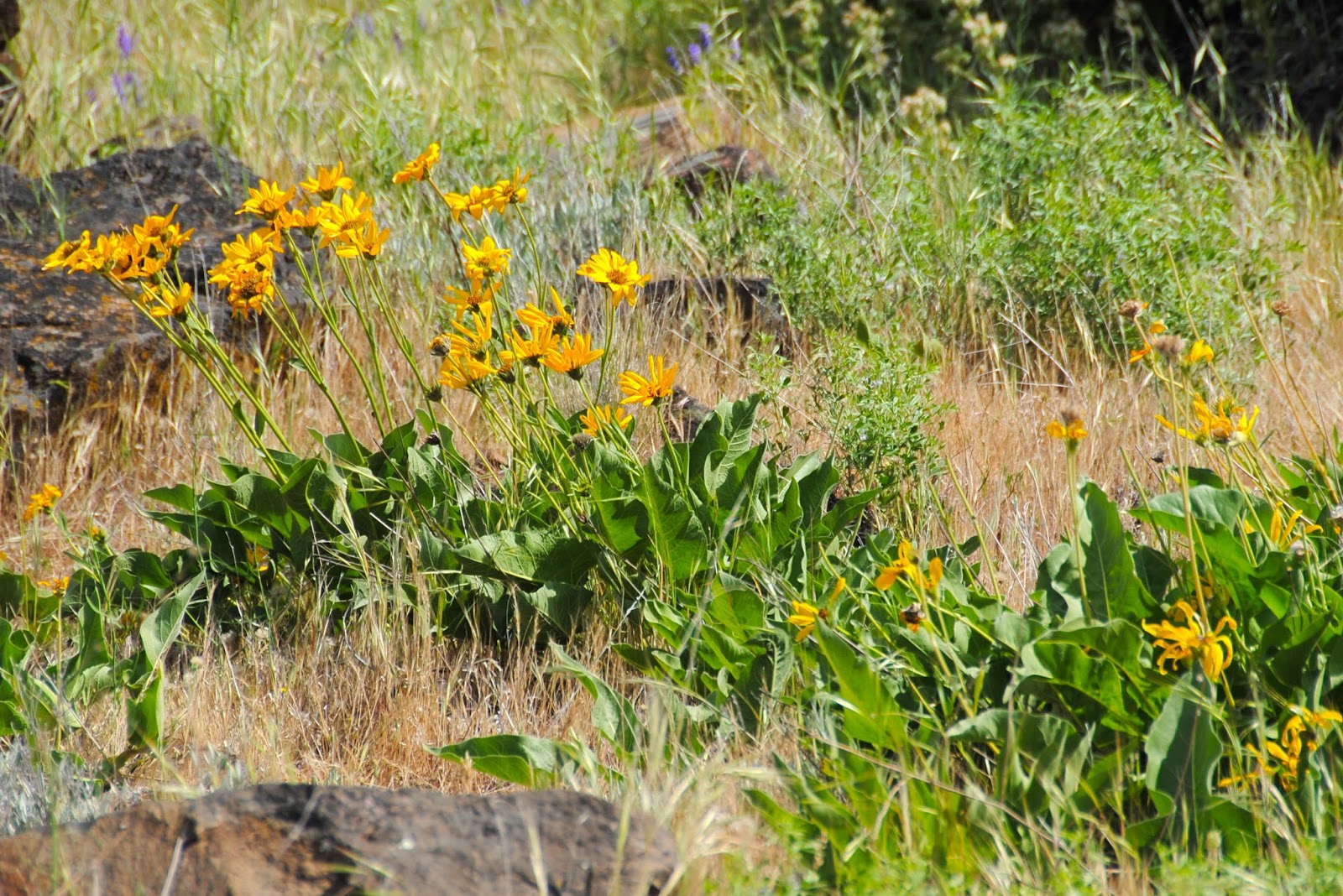
A lizard in hand is better than two on the stone. Above are a couple wildflower photos, as if there weren't enough daisy pictures in the world already.

This place, Horsethief Butte, was a popular destination for climbers, but also a great place to catch lizards and contemplate ice age geology.
The view from the top of Horsethief Butte.
More of those flowers that I'm supposed to know the name of.
Industry is everywhere. Chose one: good or bad. Well, kind of both. Though this place was raging rapids in the day of Lewis and Clark, it is now a highway for boats and barges. The energy from the dam powers the whole town adjacent.
Here's another good shot. This one must be a sagebrush lizard. 
Look how the blue spots show up so well! Of course, I did saturate this photo a little from the original.
This photo is pure fraud. Just thought it looked pretty all doctored up to bring out the pinks. Looks kind of like one of those old paintings of prehistoric times; purple sky, blue volcano, and- Hey! Where's the T-rex?

This picture is more true to the original colour of the sunset. Of course, it is impossible to replicate the vivid beauty that the human eye can produce from such light.
In the morning, I found a common garter snake near the campground, probably the valley garter snake subspecies.
Extremely placid little fellow. I gave him a kiss on the lips. That's why his cheeks are blushing red. 
If you enjoyed these photos, stay tuned for Part III!